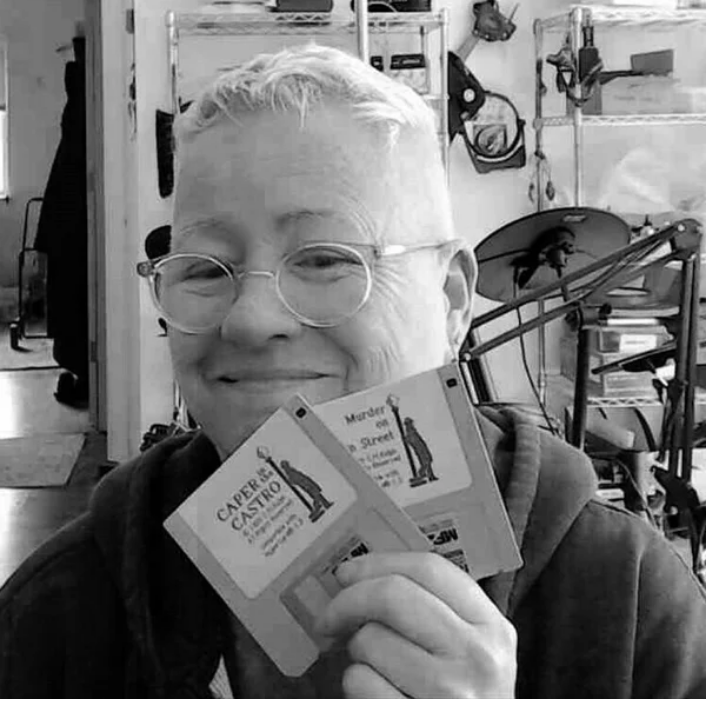
Caper developer C.M. Ralph, holding floppy disks of the game.
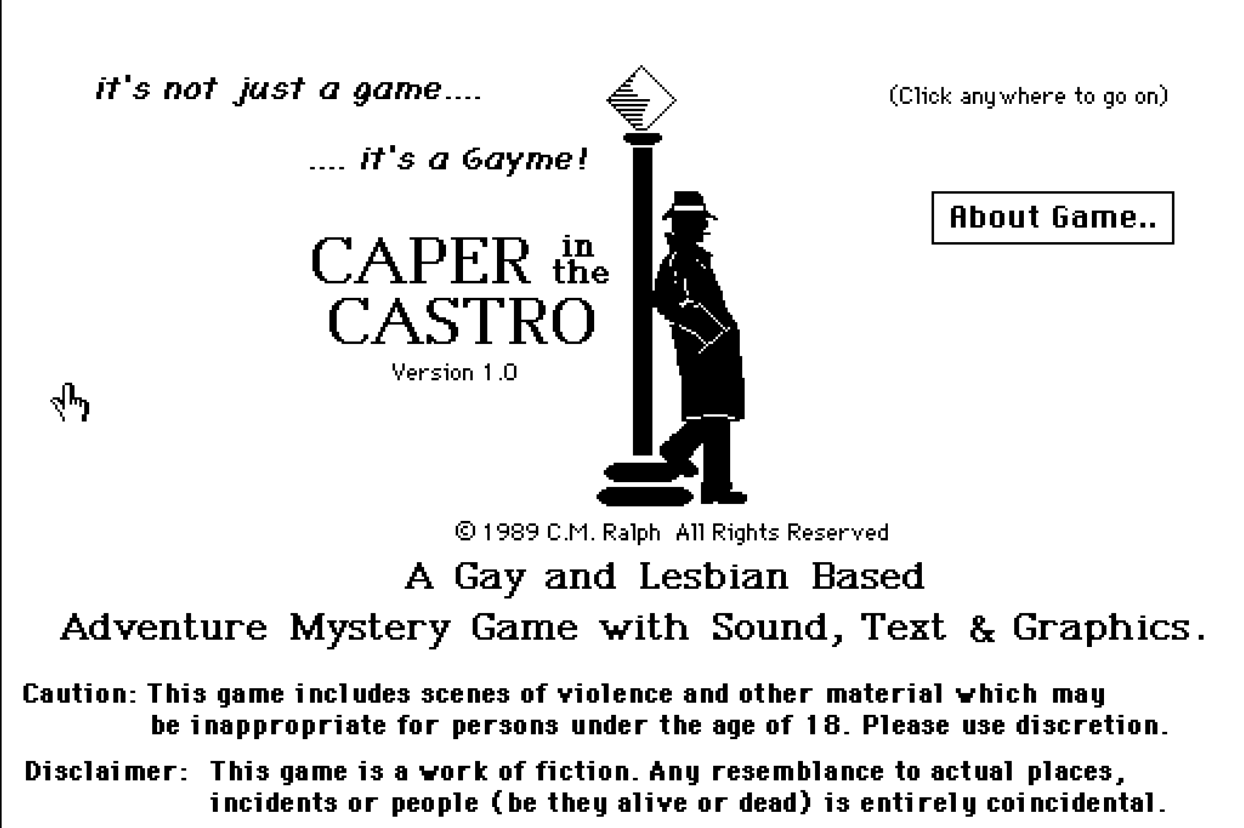
The title screen of Caper in the Castro (1989), describing it as "A Gay and Lesbian Based Adventure Mystery Game with Sound, Text, and Graphics."
Many of the bestselling video games of the 1980s were adventure games. Emulating the success of genre originator Colossal Cave Adventure (1976), these interactive fiction works emphasized exploration and puzzles. There was one topic the industry seemed largely uninterested in examining: LGBT people. Representation of queerness in this decade was scarce and often derogatory, such as the in-game description of Mad Party Fucker (1985), which read, “The object of this game is to fuck as many women as you can without getting bufu’ed by fags (contracting AIDS)” (“Mad Party Fucker”). Even Moonmist (1986), which had the first lesbian character in a video game, only implied that Vivian was lesbian and never used the word in-game (Starshine Scribbles). But in 1989, a murder-mystery/puzzle solving adventure game came out that would become known as the first LGBT video game: Caper in the Castro.
Caper was created by C.M. Ralph (they/them), who is not a professional game developer—after a career in manufacturing, they retired to become a full-time multimedia artist. However, when they moved from Southern California to the San Francisco Bay Area, “C.M. wanted to do something for the LGBT community that had embraced them and their partner while also honoring the nearly 90% of their Southern California friends who had died from AIDS related illnesses (“Caper in the Castro”). As such, Caper was released as “Charity Ware,” with players asked at the start of the game to donate to an AIDS charity of their choosing.
Caper’s origin as a labor of love is further shown in its content. The game follows Tracker McDyke, famous lesbian detective, on the hunt for her drag queen friend Tessy LaFemme, who disappeared after telling Tracker she had dirt on the villainous Dullagan Straightman. Players explore Castro Street (a fictionalized version of the Castro District), clicking on the environment and using tools to find clues and uncover Straightman’s sinister plot. This is clearly not a game concerned with subtlety—it is blatantly, unapologetically queer. While Vivian could only allude to her “sweet Deidre,” Tracker can ogle a naked woman with breathless attraction. Ralph filled Caper with “a lot of inside humor for the LGBT community at that time” (“Caper in the Castro: The First LGBT Video Game”). For instance, observing a sapphic couple at The Red Herring Cafe, McDyke can comment, “I bet she always makes sure she spells it ‘wimmin’ instead of women” (Caper in the Castro). On a more serious note, the plot is heavily inspired by the AIDs crisis and the community’s fears of annihilation.
Caper was a huge success by the standards of the eighties. Five years after being posted on an online LGBT bulletin board, ~250,000 copies had been downloaded (Zomorodi et al.) More importantly, it was a celebrated landmark for the queer community—the first time someone had made a game with explicitly LGBT characters and themes. When Cynthia Yockey covered it in a November 1989 issue of The Washington Blade, she credited the developer for bringing expression of gay and lesbian lives to a medium that had been sorely lacking them. Over 30 years later, Ralph receives 10-15 emails annually thanking them for their work (Zomorodi et al.).
If you want to play Caper in the Castro yourself, you’re in luck: it’s available on the Internet Archive here. Speaking from my own experiences, it definitely suffers from typical point-and-click adventure game jankiness, especially nonsensical puzzle solutions. That being said, I’d still recommend checking it out as a monumental step forward in queer representation.
Starshine Scribbles. “The Text Adventure That BROKE BOUNDARIES #Gaminghistory #Retrogaming.” YouTube, 13 June 2026, www.youtube.com/watch?v=hSToiIkhmvc.
Yockey, Cynthia. “Tracker McDyke matches wits with Dullagan Straightman.” The Washington Blade, 3 November 1989, p. 26.
Kacey Merkelson is an intern at Sinister Wisdom for the summer of 2026. She recently graduated Hunter College with a B.A. in English. In her spare time, Kacey enjoys reading, playing D&D, and looking at cute cats.
Outside the West is an unexpected niche of Chinese queer media: baihe (featuring WLW romance) and danmei (featuring MLM romance). With growing popularity in mainland China, these books explore non-normative / queer identities, despite the commonly known harsh and repressive censorship of the Chinese government.
Baihe and danmei differ significantly from Western queer romances though they are influenced by Western slash fanfic. Heavily influenced from their Japanese counterparts, yuri and yaoi, baihe and danmei emerged as online literary genres steadily gaining foothold and popularity in mainstream culture. Rooted in female fandom spaces, these same sex romance novels are created by and for women and sexual minorities.
Most conversations about queerness in China focus on rights and visibility, so these works rarely get attention. Since 2019, the Chinese state has employed several directives, repressing queer right groups and increasing censorship of queerness, extending it to “sissy men” (feminine men). Several LGBT chat groups and organizations in China have closed.
These web novels are self-published on several sites (where they are then translated by online groups into English and other languages), but state censorship has also made these sites, and associated writers, self-censored for fear of state interference. Authors and readers in this genre are difficult to uncover as most of these novels are published online under pseudonyms. Authors’ identities are further hidden due to censorship. Readers encounter the novels online and read anonymously. Despite this, some titles still circulate and secure deals for censored domestic (romantic elements reduced to friendship) and foreign publication.
Two prominent publishers are Rosmei, with distribution in Singapore, and Seven Seas distributing to North American markets. Most of their novels are of the danmei genre, paralleling the difference in popularity between sapphic and MLM romance in the West. (Readers gravitate more to MLM romance than sapphic stories.) Recently, three baihe novels have been officially published in English: The Beauty’s Blade: Mei Ren Jian by Feng Ren Zuo Shu (Seven Seas), The Creator's Grace, and At The World's Mercy by Ning Yuan (Rosmei). Other novels are still only accessible through online unofficial translations; the most popular within English speaking fandom (according to posts on r/Baihe subreddit) is The Dragon by Tai Yangjun, which has not yet had an official translation.
Despite limited choices, the English title The Beauty’s Blade invites readers into an intense enemies-to-lovers romance between two rival swordswomen (perhaps the sapphic predecessor of Heated Rivalry?), while The Creator's Grace offers a drama full of secrets and betrayals between Ran Jin and her late girlfriend’s sister, and At The World's Mercy explores a sapphic relationship embroidered with court intrigue in the matriarchal realm of Great Yu.
The roots, environment, authorship, and audiences of baihe (featuring WLW romance) and danmei (featuring MLM romance) do not quite align with underground queer literature, which is grounded in queer culture. These novels sit at a crossroads of popular heteronormative culture and queerness. Baihe and danmei are their own genres, listed next to romance, not a subset of it, aligning with heteronormative culture and signaling queerness as other. Nevertheless, these novels have transformative power, increasing representation of queerness for Chinese readers, and offer space for imagined future and past through their seemingly lesbophobic-devoid utopia bubble.
Further Reading:
The Dragon by Tai Yangjun by Tai Yangjun (Jinjiang Literature City, 2019)
A fantasy adventure interweaved with bitter tragedies where romance takes a back seat but is still no less crucial to the plot and the relationship between Gu Fuyou, an ordinary disciple (term for martial art student in Chinese fantasy genres), and her accidentally summoned spirit Nanzhu Jun.
Her Mountain, Her Sea by Fuhua (Jinjiang Literature City, 2020) Her Mountain, Her Sea is a slow slice of life story following the high school days and budding romance of our two main characters, Chi Tang and You Yu, while they grapple with their family problems and expectations.
“Ponds are a dead pool of stagnant water; does the wandering fish still want to live in this pond?”
“I do.”
The Beauty’s Blade: Mei Ren Jian by Feng Ren Zuo Shu (Seven Seas, 2025)
“The baihe/Girls’ Love novel originally written in Chinese and available in English for the first time! Two powerful swordswomen face off in this enemies-to-lovers historical tale.”
The Creator's Grace Vol. 1 by Ning Yuan (Rosmei, 2026)
“She came home for the truth. What she found was the woman who took everything… and wanted her most of all.”
“The Creator’s Grace is a gripping sci-fi romance about fractured identities and impossible salvation, where love may be the only truth that holds.”
The Creator's Grace, Poster (Source), Drama CD, Weibo
At The World's Mercy Vol. 1-2 by Ning Yuan (Rosmei, 2026)
“At the World’s Mercy is a masterful work of baihe historical fiction, weaving espionage, slow-burn romance, and political ambition into a tale as elegant as it is ruthless.”
Thy Vu (they/he) is a Sinister Wisdom intern and a graphic designer. They have a BA in Growth and Structure of Cities from Bryn Mawr College. They are interested in exploring how (online) space is adapted and queered, as well as foodways within queer communities and spaces.
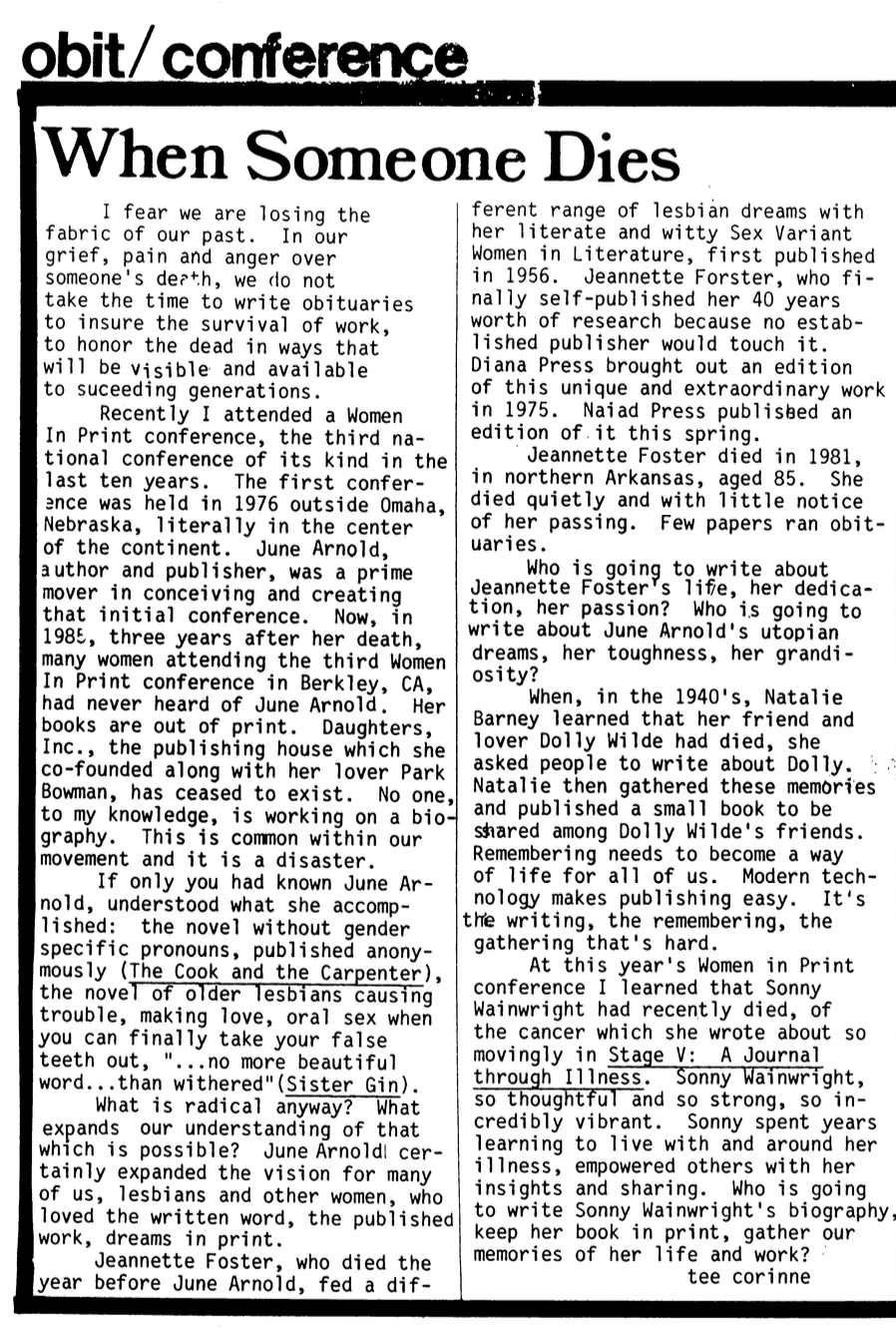
Caption: “When Someone Dies” by Tee Corinne, off our backs, Vol. 15, No. 8 (august-september 1985), p. 18.
In 1985, Tee Corrine wrote in off our backs, “I fear we are losing the fabric of our past.” She continued “in our grief, pain and anger over someone’s death, we do not take the time to write obituaries to ensure the survival of work, to honor the dead in ways that will be visible and available to succeeding generations.”
I reread this article recently and these sentences strike me as remaining true today. We collectively in lesbian and queer women’s communities are losing the fabric of our past, and there are not enough people dedicated to honoring our dead and doing the labor to continue their survival. There are many reasons for this situation—and many remedies. The loss of the ReviewLambdaLiterary.org now over two years ago means that there is not a public, highly trafficked website for obituaries of lesbian writers, and too often our luminary literary lesbians are not of interest to mainstream publishers of obituaries like The New York Times. At Sinister Wisdom, we publish obituaries and remembrances in the quarterly journal, but I know we do not dedicate enough pages or attention to this important work. Lesbian Connection is publishing obituaries valiantly. Their obituaries are wonderful and provide portraits of a wide range of lesbians and lesbian lives. If you are not receiving LC, I encourage you to sign up for either the print or PDF version of the magazine. It is a treasure trove of our past—and our present (and the futures we are creating).
Corinne misses not only obituaries but also a wide range of activities that keep a lesbian / queer woman’s life and work alive and meaningful to new generations. These activities include republishing books, excerpting books in new contexts, continuing to circulate art, and more. Corinne writes in the off our backs article “When Someone Dies” about June Arnold, who died in 1982, three years before the article was published. Corinne notes that many women attending the women in print conference in Berkeley, CA in 1985 “had never heard of” her and that “no one . . . is working on a biography.” There is still no biography of Arnold. Corinne continued, “This is common within our movement, and it is a disaster.”
One person doing extraordinary work to preserve our lesbian past particularly through biography is Tracy Baim who has published a biography of Vernita Gray and Barbara Gittings, among many other important lesbian history books. We need at least ten more Tracy Baims!
In the article, Corinne also mentioned Jeannette Foster, who Joanne Passet wrote about in the biography Sex Variant Woman, Natalie Barney, Dolly Wilde, and Sonny Wainwright. Corinne’s concluding words were, “Who is going to write Sonny Wainwright’s biography, keep her book in print, gather our memories of her life and work?”
Who indeed? Sinister Wisdom is doing some work to keep books in print and gather memories of lesbians' lives and works, but there is always more to do. I invite everyone to join in this work. Write obituaries; submit them to Lesbian Connection, to Sinister Wisdom and the Sinister Wisdom blog. Champion the work of our lesbian and queer women forbears. Edit them, publish them, keep them in our memories and on our shelves, give their work new contexts and new meaning. There is much work to do; it is incumbent on us all to contribute. Far exceeding the call of duty and obligation is what we gain in meaning and joy.
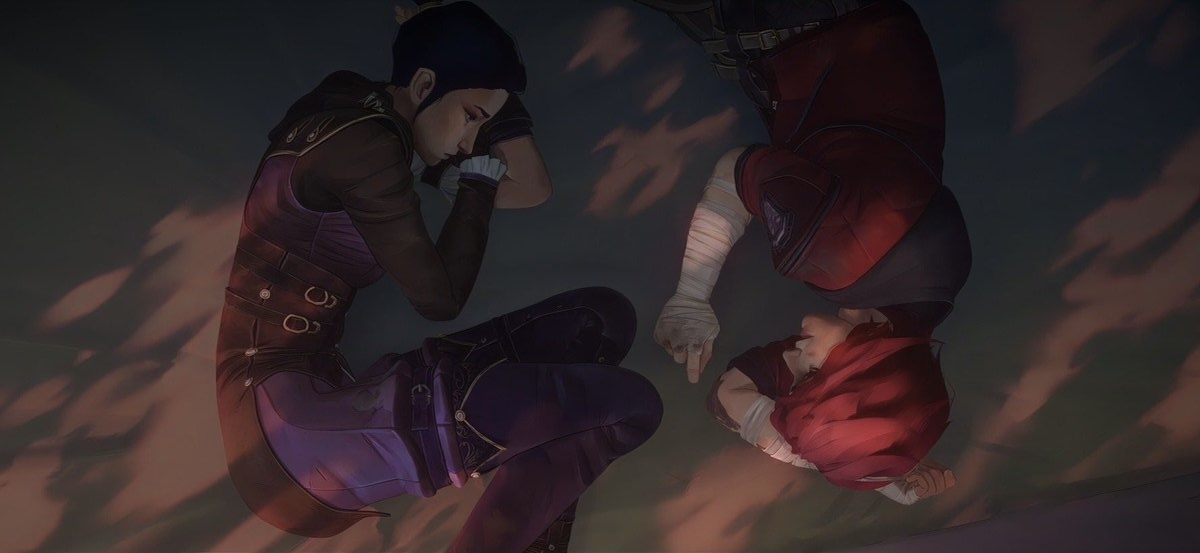
Caitlyn (left) and Vi (right) from TV show Arcane.
Arcane, the television show on Netflix which debuted in November of 2026, gives a new, queer view of love. In Arcane, love doesn’t just show up in the pretty, romantic, and fluffy ways. It is instead dark, ugly, and pushes the characters to do horrendous things throughout the show. But there is never a doubt that at the center of it, the main characters’ love, Caitlyn’s and Vi’s, no matter how brutal, is what makes Arcane magical.
The fictional world of Arcane has a complex political hierarchy. Piltover is at the top of the power structure, holding most of this world’s resources. At the very bottom of this system is the Undercity, an industrialized and mostly impoverished part of society. Arcane follows the ongoing clash between these two cities, which is heightened when a scientist introduces a drug called shimmer in the Undercity. The politicians in Undercity use the drug to amass more power. Meanwhile, Piltover increases its security and restrictions for the Undercity, widening the wealth gap. These tensions between the two cities are experienced through the characters of Caitlyn, an enforcer from Piltover, and Vi, an Undercity brawler.
These two are characters that never should have met. Caitlyn grew up very privileged in Piltover and sheltered from the real world. In the Undercity, Vi experienced the brunt of the economic, political, and social repression. Caitlyn descends into the Undercity against all warnings to figure out what is really putting people at a disadvantage and to really make positive change as an enforcer. In the process, she finds and frees Vi, who has been wrongly imprisoned for years because of an accident that killed people in the Undercity. Together, they embark on a journey that teaches them more about each other’s worlds. Caitlyn sees the injustice that her home, Piltover, has a part in, and Vi comes to realize that not all people with power, such as Caitlyn, are bad.
The relationship between Caitlyn and Vi is not only a lesbian relationship, but it also has a butchfemme dynamic, which is a lesbian cultural identity between two women, one that is more masculine-presenting and one feminine-presenting. More than that, butchfemme is a dynamic that historically and currently protects and uplifts the lesbians in the relationship, with the subversion of gender roles and support the couple shows each other. In Arcane, Caitlyn is tall, shy, but confident. She does her best to protect Vi, the more masculine yet soft protagonist who cares for the people she loves in such a distinctly butch way. Despite being from different parts of society, they figure out a way to do good together, even if it’s rocky sometimes. For instance, when looking for Vi’s sister, Vi joins Caitlyn’s investigation to make sure that they do not disrupt the Undercity more than Piltover already has with its resources. This dynamic is distinct from other forms of mainstream lesbian media that have come out in recent years. There is not another recent television show that features a main lesbian couple with one being femme and the other being butch. First Kill, Killing Eve, The Fosters, The Haunting of Bly Manor, and many others all feature lesbian couples as the main couple; however, they are not butchfemme. Arcane is a unique modern show to have a butchfemme lesbian couple, and one that is not one-dimensional or stereotypical.
Caitlyn’s role is as an enforcer, basically a police officer, and Vi, who has been abused by the system, impacts the way this butchfemme relationship plays out. What starts as a seemingly innocent relationship turns toxic as Caitlyn grows corrupt, stricken with grief over the death of her mother by Vi’s sister, and Vi has to leave her at the beginning of season two to find her own path. Some fans argue that the butchfemme label shouldn’t be used for them because of the power dynamic between Caitlyn and Vi, with Caitlyn being more privileged. Yet, their relationship shows the nuances of butchfemme and how these characters’ history and trauma go beyond just the aesthetics of a relationship between masculine and feminine women.
From the middle of season one, Vi helps Caitlyn realize that the issues of their world won’t be fixed by playing into the oppressive system, and Caitlyn shows Vi that despite them having different backgrounds, they can help each other. Their love is what helps make the world a better place, and their love uplifts and honors each other, which is what butchfemme is really about.
Sudeeksha Dasari is a recent graduate of Mount Holyoke College. She has worked in editing and marketing at Science, Naturally! in DC, and aspires to work in publishing post-graduation. Throughout her entire life, she has loved writing, whether it be fiction writing or poetry, which is what led to her pursuing a degree in English and Philosophy. Alongside literature, she loves spending time with her German Shepherd and practicing Bharatanatyam, a classical Indian dance style she’s been doing for 16 years.
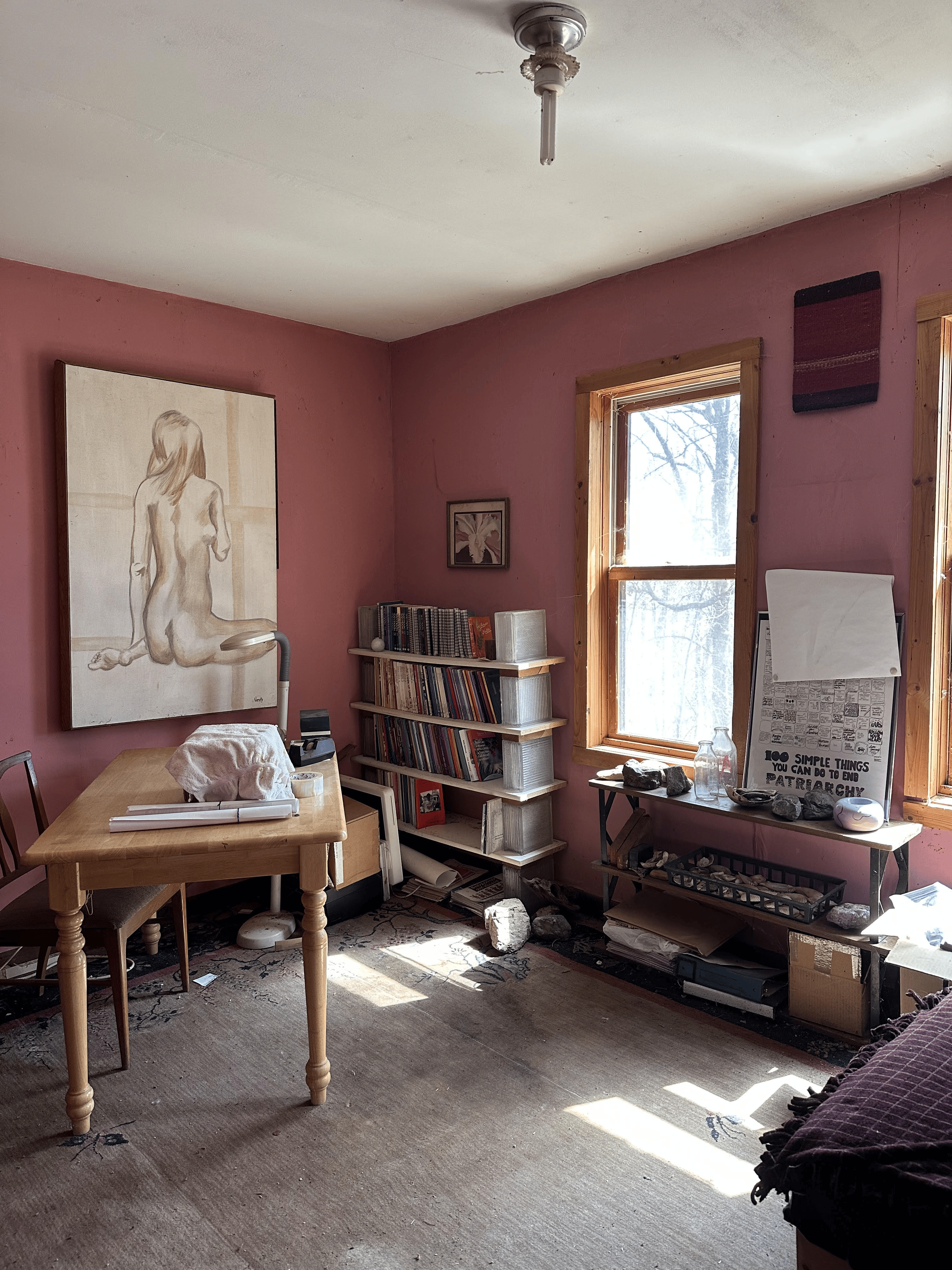
In April, we (Ella, a college student and former Sinister Wisdom intern, and Sam and Katie, two local literature-loving lesbians) spent several hours at the Web: a farm in central Minnesota run by the incredible Nett Hart.
Nett is a lesbian activist from St. Paul, Minnesota, who co-purchased the Web in 1980 after she grew interested in women’s land. She lives on the land: farming, making art, and hosting both lesbian events and wandering lesbians passing through.
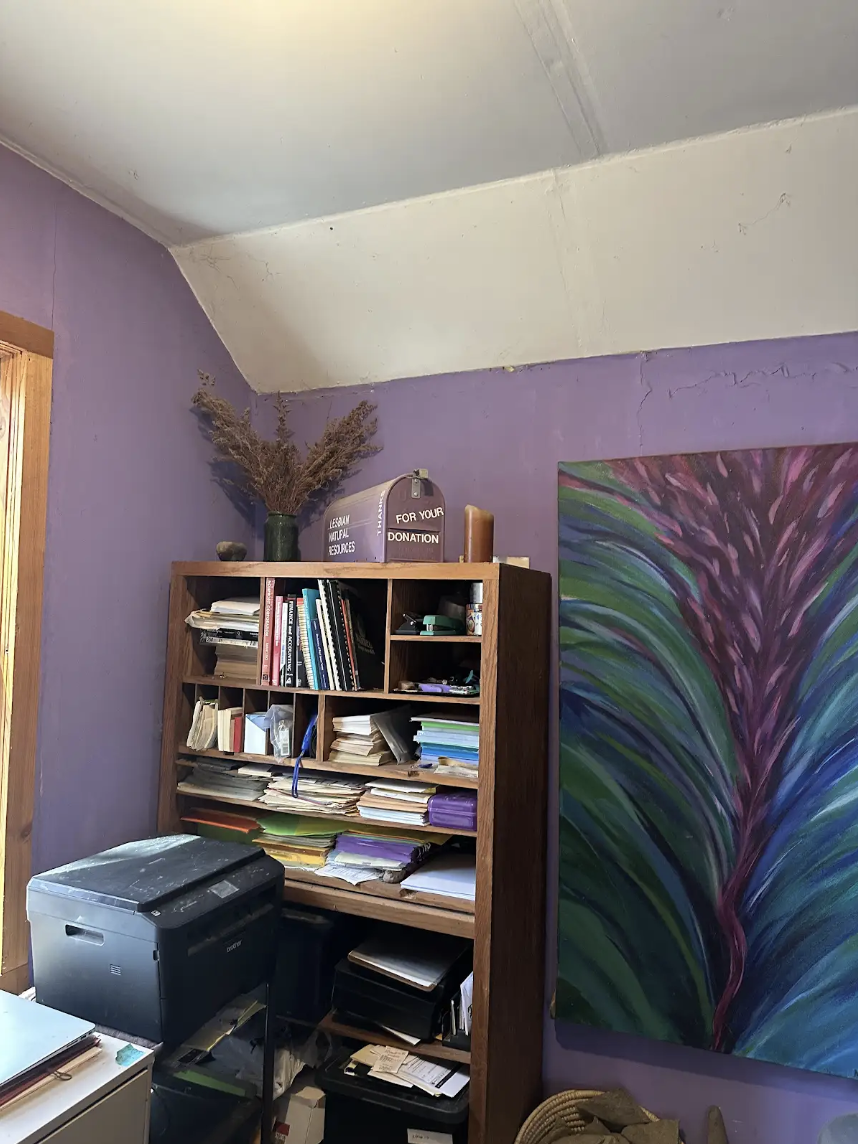
Immediately upon arrival, we could tell we were in a special, queer space—a place we soon learned was once condemned but salvaged by Nett with her own hands and skills. Each room was painted a different color and decorated with art that Nett and other lesbians had created, as well as ephemera from feminist and lesbian collectives past and present. But greatest of all were the books: one shelf spilled over with books on plants and gardening; another sported feminist and lesbian journals, including every copy of Sinister Wisdom; and Nett’s room was bursting with feminist and queer theory. I asked her how many books were in the house, and she said that she didn’t know, but she had read them all.
We had lunch and dinner with Nett, eating lentils and vegetables that she had grown on her land. We talked about our homes, experiences in Minnesota, experience or lack thereof with okra, and the writing and work we hold dear. Our conversations lingered long after we’d already finished our seconds.
This type of intergenerational queer connection is often missing in the lives of even those in the strongest queer communities. We are not often born into families with other queer people around, and our society is not structured in a way that encourages friendship between people of different ages. Given this, all of us around that table were grateful that we had sought out this connection.
I (Ella) especially loved getting to ask Nett about the feminist lesbian periodicals I saw around her house, her art and writing, and her experiences being queer in Minnesota earlier in her life. I moved to St. Paul for college three years ago, and I had known about the highlights of queer life in the Twin Cities in past decades—especially Amazon Bookstore, a feminist and queer-owned bookstore and community institution—but had lacked the broader context of lesbians who came before me in my new city.
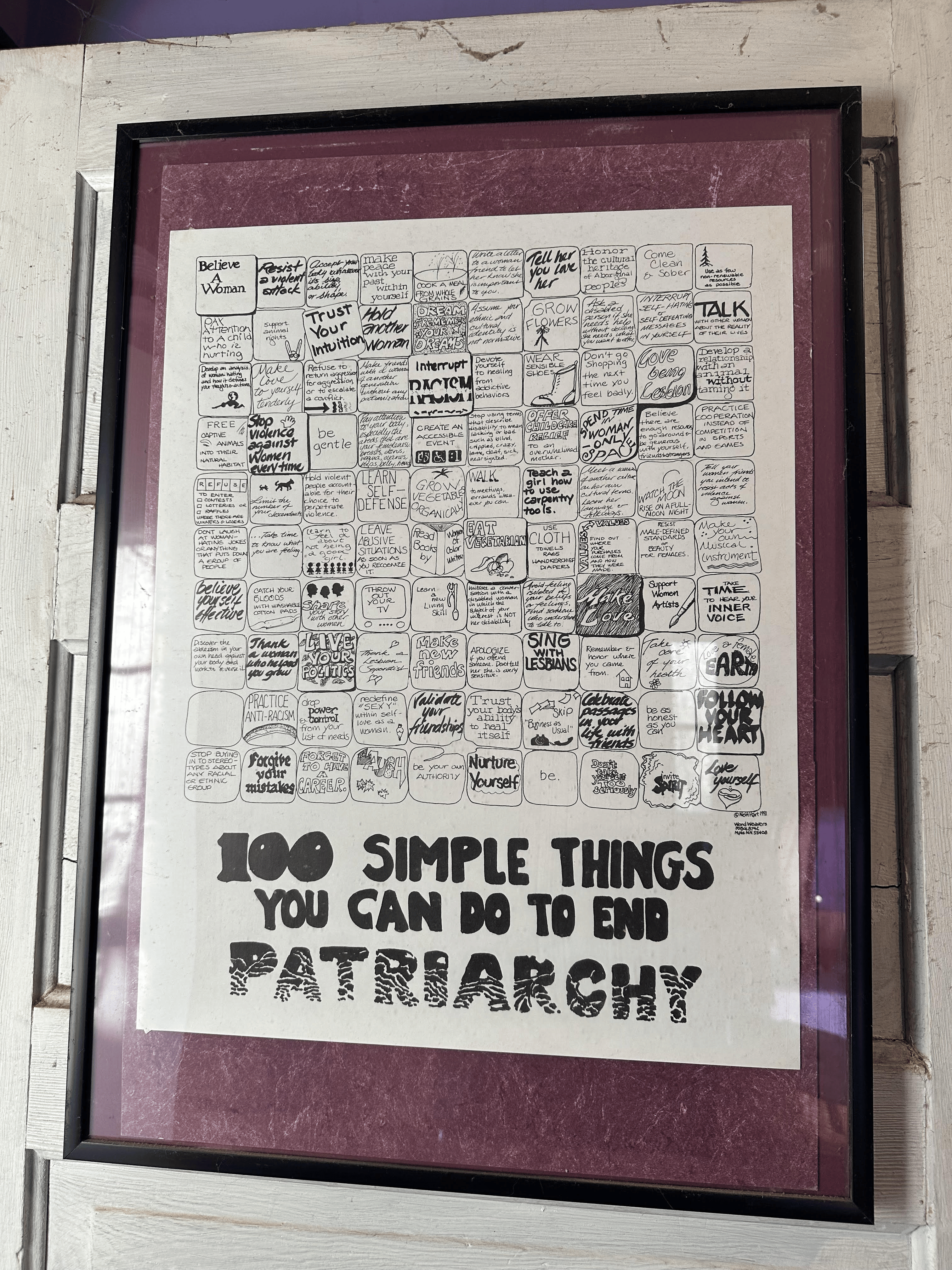
We left the Web many hours later, laden with copies of books that Nett and Lee published, “100 Simple Things You Can Do to End Patriarchy” posters that Nett designed in different languages, some pots for my new basil plant—and an invitation to return and continue the intergenerational conversations we had started.
Note: Nett wants the community to know that print copies of the books she and Lee published (the Almanacs of Lesbian Lore and Vision - Ripening, Dreaming, and Awakening) her book Spirited Lesbians are all still available for purchase. She sells the set of four books for $25, which includes postage as a special to the Sinister Wisdom community. People interested in purchasing can send a check or money order to Nett Hart, PO Box 53, Foreston, Minnesota 56330.
Ella Stern is a rising senior at Macalester College and a journalist living in St. Paul, Minnesota. Her journalism focuses on the labor movement, and she loves to write and talk about queer spaces and intergenerational queer connection.
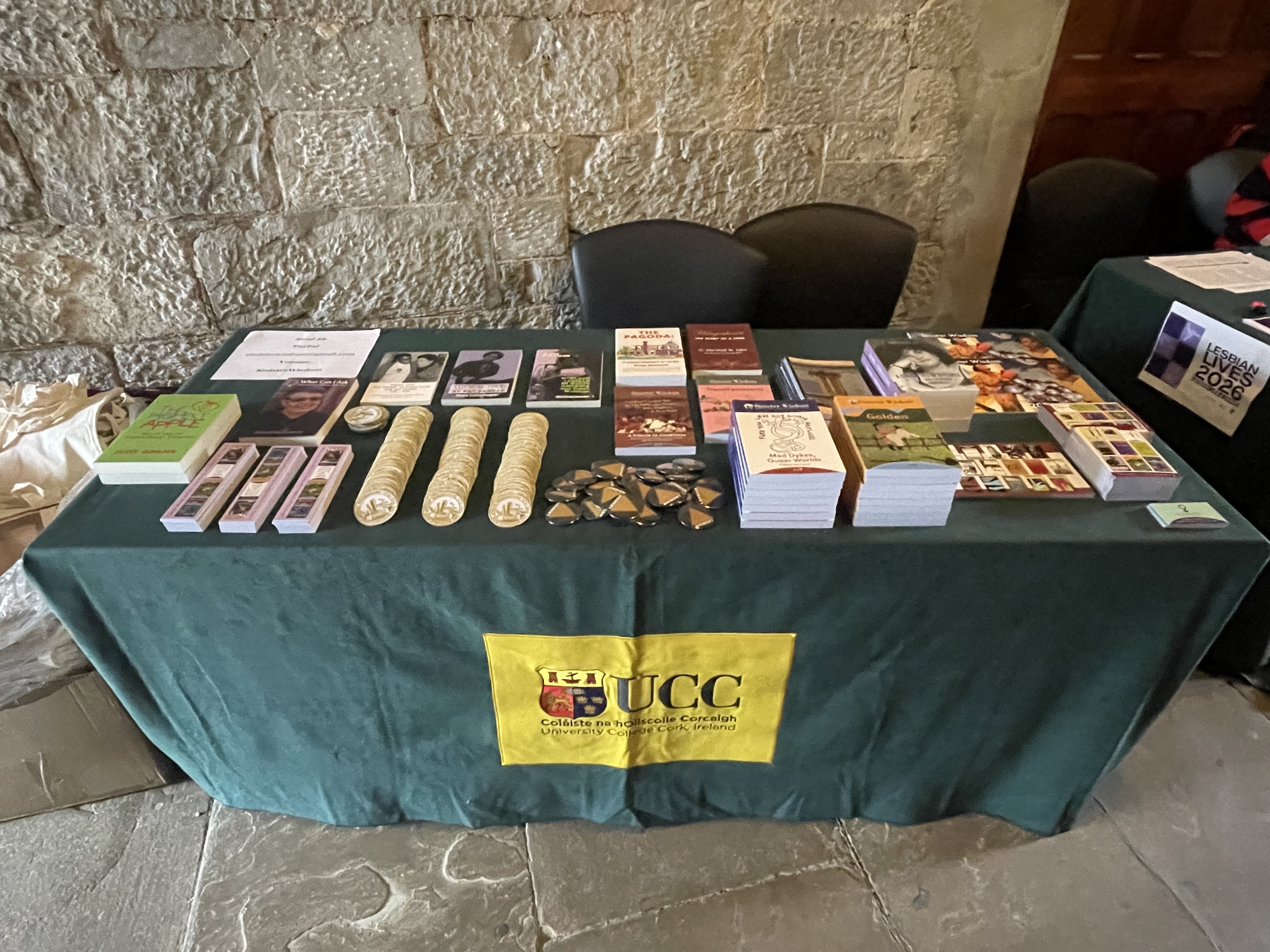
Picture of the Sinister Wisdom table at Lesbian Lives 2026.
This year’s annual Lesbian Lives Conference took place within its original stomping ground of Cork, Ireland. As I was serendipitously obtaining my MA up in Dublin, I had the privilege of attending the conference as a representative for Sinister Wisdom! I boarded a 6 am train with a few boxes of lesbian memorabilia (they were heavy—I had underestimated the weight!) and made my way to the University College Cork’s beautiful campus just in time for registration.
Conference speakers truly embodied the theme of ‘Lesbian* Life & Living’, and event organisers took incredible steps to engage with the local Cork lesbian/queer community, who organised after-conference events such as a cabaret, poetry readings, and numerous DJ sets. Keynote speakers included Dr. Aoife Neary of UCC, Karen Washington of the QT+BIPOC centered Rise and Roots Farm based in the Hudson Valley (US), as well as Lisa Fingleton and Rena Blake representing their ‘eco-social arts project’ The Barna Way based in County Kerry (Ireland). Additionally, authors Catherine O’Donnell alongside Chloe Michelle Howard discussed the queer un/becomings in their respective novels – SLANT and Heap Earth Upon It.
I had the absolute privilege of talking with and befriending more lesbians and queers in one weekend than I’ve encountered my whole life! If I did my job well, hopefully some of them are now reading this very article. Although I didn’t get the chance to enjoy the majority of panels given my time tabling for Sinister Wisdom, I experienced the residual excitement running off the consistent stream of lesbians passing by my booth who were more than happy to spend a moment (or many, if I could convince them) talking with me about their work, their ideas, and their own lesbian life, now in brief collision with mine. I felt the freedom to engage in conversation beyond the simple pleasantries of exchange, and found myself swapping emails, Instagrams, and advertising both local and international fliers, projects, and archives once I’d given away the majority of Sinister Wisdom merchandise. Particular panels include beautifully cheeky titles such as ‘Fingering the Archives’ and the more sobering ‘Resistance in Times of Violence’, reflecting both the energy of urgency and unabashed joy that flavored the whole weekend. Film screenings such as “Free Beer Tomorrow” co-produced and directed by Julia M. Applegate and LuSter P Singleton were such a hit amongst conference-goers that LINQ Ireland, a Cork-based lesbian and queer organisation, set-up an impromptu, secondary screening to meet demand.
Additional films and panels were incredibly local to Cork. For example, “Loafers”, a documentary covering Cork’s longest running gay bar of the same name and directed by Cork LGBT Archive founder Orla Egan left not a dry eye for those in attendance. Events following the conference’s end further provided a truly intergenerational sight of lesbian loving, belonging, dance, and discussion I haven’t before experienced. There’s something to be said in seeing an older butch absolutely destroy the dance floor that really adds decades to your life and makes you realise that perhaps queer utopia does exist in these brief, incandescent flashes.
Founded in Ireland in 1994, the Lesbian Lives Conference is an ever-evolving, always becoming event that creates an unequivocally lesbian, queer space ripe with discussion, critique, and joy. The next conference is currently rumored to set up shop in Toronto. Hopefully, with a bit of luck, I’ll see y’all there!
Sam Carter is an MA graduate student at University College Dublin in Archives and Records Management. Her upcoming dissertation explores the significance of archival spaces and nostalgia within queer southern archives. You can connect with her Instagram @sam.carter83.
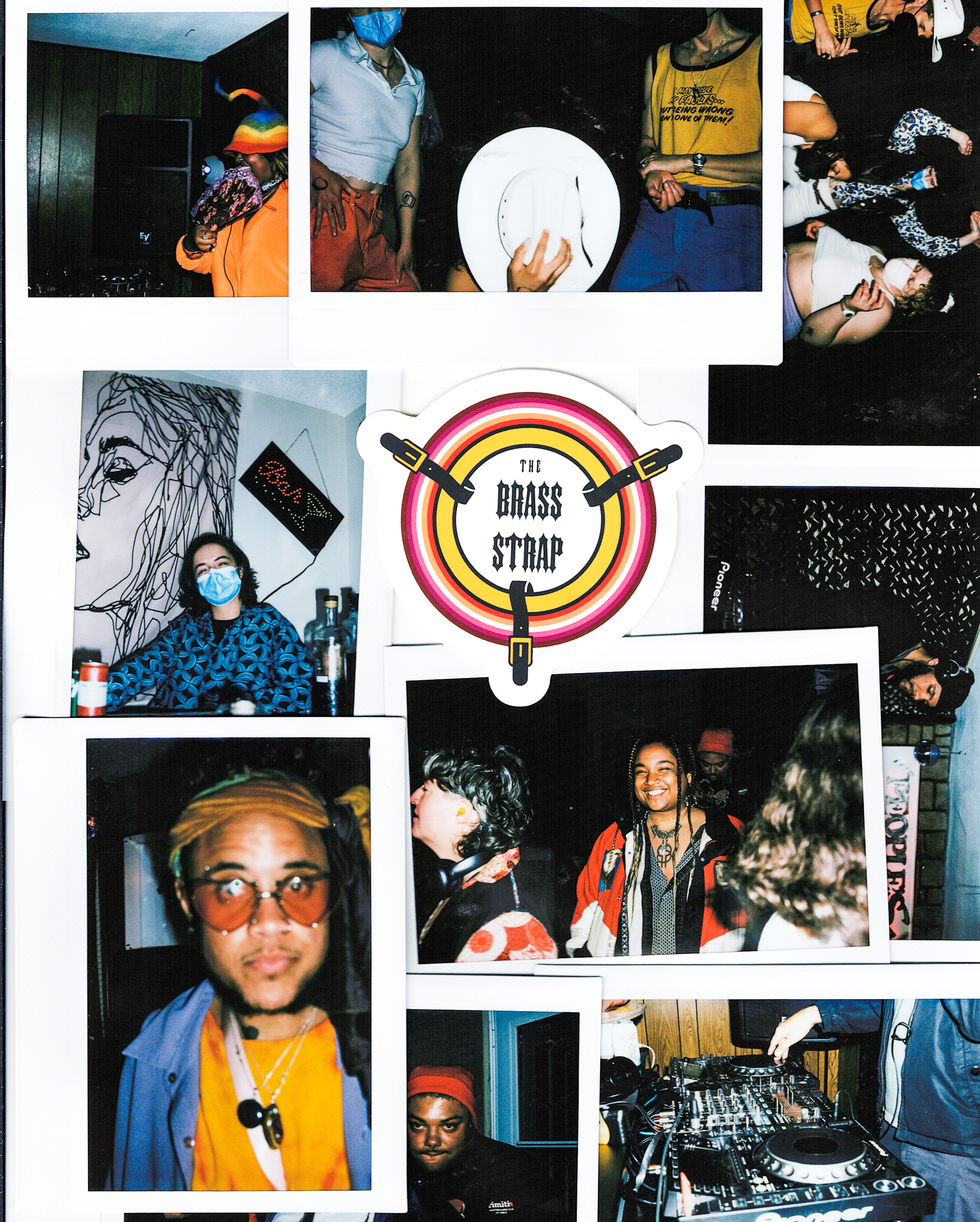
Polaroids from a Queer 70s-themed house party that the Brass Strap threw.
In the late 1980s, the United States had over 200 lesbian bars. That number hit a low in 2019: only an estimated 16 across the country. A new wave of lesbian bars has opened since, numbering an estimated 37 today. In Minneapolis, the Brass Strap hopes to provide a safe, community-oriented space for Twin Cities sapphics and become number 38.
Several years ago, CJ Jennings, one of the Brass Strap’s original co-founders, was freezing in the Minnesota cold, having left a punk bar to share a queer kiss somewhere that felt secluded and, therefore, safer. They decided, then, that Minneapolis needed a lesbian bar.
“We need to have a space where we don't have to go outside to a back corner in the dark just to have a first kiss,” Jennings said. “We want to be in the light like everyone else.”
Jennings and their co-founders built a coalition and started fundraising, keeping the goal of a safe space in mind all the while. At an early event, an art market and fundraiser with DJs and dancing, some attendees said that “being there was like the first time that they felt [in public] like they could dance as if they were at home,” Jennings recalled.
In the early stages of their work to open the Brass Strap, some of the original co-founders road tripped around the country to visit bars and talk to their owners. Inspired by the Lesbian Bar Project, they created a documentary to showcase the bars; they also learned from the experiences of these bars and their communities.
“We heard from a lot of Black and brown queer people across all of our interviews that the one thing that lesbian spaces need to do better at is being more inclusive,” Jennings said. “People should not have to choose which identity they want to feel seen in, in a space that they go into.”
Across the interviews that Brass Strap founders conducted, community members stressed the need to keep Black and brown people at the forefront when creating events and spaces, down to the programming and music.
To strengthen their racial inclusivity, the Brass Strap has been engaging in coalition work and building intentional relationships, according to Jennings. They have also held mutual aid events, including a in partnership with Sappho’s Social Club, to support neighbors affected by ICE’s occupation of Minnesota. Jennings sees this work as “showing up for people who need the help, and building community that way, rather than just putting out a statement.”
The co-founders are also working to build an intergenerational space. To do so, they have visited older lesbians’ spaces and “[felt] that level of community that had been built over so long,” Jennings said. There, they have talked with older lesbians and told them about the Brass Strap in hopes of bringing them in.
To Jennings, inclusivity is crucial because queer spaces remain necessary for all to access.
“Historically, queer spaces and queer-inclusive spaces have been the only places that people can actually be themselves,” Jennings said. “I think now, with people being able to be more out and open, people have told themselves that we don't need these spaces anymore. … And I just don't think that that's true.”
The co-founders are aiming to further prioritize community through the bar’s unique model.
The Brass Strap is structured as a multi-stakeholder co-op, a format that, when combined with a liquor license, has never been done in Minnesota. Within this model, workers will become owners, and customers can choose to be owners. This format stems from a belief that decisions “need to be made by the workers and the customers,” Jennings said.
The co-op currently has about 70 member-owners, at various tiers of membership. All member-owners are able to vote on decisions, run for the board, and serve on committees.
This unprecedented model has complicated the opening process; for instance, it took the co-founders three years to find a lawyer who could satisfactorily structure the co-op. However, Jennings sees the community input that this model allows as a necessary investment in the bar’s future.
“We would be open right now if we dropped the co-op formation,” Jennings said. “But the thing is, we would be open right now, but we might not be open tomorrow.”
The Brass Strap’s co-founders have toured at least a dozen potential bar locations since December 2024. Although Jennings said the co-founders are the closest they have ever been to locking down a space, they are not yet ready to announce what that might be.
Once the bar opens for good, Jennings is most excited for people “to make huge memories there. I can’t wait for our first wedding at the bar. … Working in the service industry, those were always my favorite parts: hearing how a space can be so important to someone.”
Jennings hopes that, from the work that they and their co-founders have put into the Brass Strap, others learn that they can open a lesbian bar, too.
“None of us have really ever felt like any other space was competition for us—and not in a cocky way, but in a way of abundance mindset rather than scarcity,” Jennings said. “Capitalism wants us to think that there is a scarcity in everything and in everyone, and that's just not true. We [queer people] are abundant, and we deserve an abundance of choices.”
Ella Stern is a rising senior at Macalester College and a journalist living in St. Paul, Minnesota. Her journalism focuses on the labor movement, and she loves to write and talk about queer spaces and intergenerational queer connection.
“And the metaphorical lenses we choose are crucial, having the power to magnify, create better focus, and correct our vision.”
― Charlene Carruthers
"Your silence will not protect you."
Audre Lorde
“It’s revolutionary to connect with love”
— Tourmaline
"Gender is the poetry each of us makes out of the language we are taught."
― Leslie Feinberg
“The problem with the use of language of Revolution without praxis is that it promises to change everything while keeping everything the same. “
— Leila Raven