subscribedonate

Mel's blog

Nomination Announcement

Sinister Wisdom is pleased to announce our award submissions for the Pushcart Prize, Lambda Literary Award, Firecracker Award, and Orison Books' Best Spiritual Literature.

Pushcart Prize
[Clocks chime—what time is it?] by Marina Tsvetaeva translated by Sonja Franeta
“Next Book” by Cheryl Clarke
“Wife Loved Like a Garden” by Sarah Horner
“Barbie Fantasia with Guest Appearance by Jacqueline Susann” by Veronica Wasson
“Mosaic II” by Diya Abbas
“Appetites” by Aliyah Blattner

Lambda Literary Awards
LGBTQ Anthology: SWANA Dykes edited by Nikki Luna and Khadija Pitts-Ceesay here.
Lesbian Fiction: A Dove Under My Hand: Sapphic Writings by Marina Tsvetaeva translated by Sonja Franeta here.
Lesbian Memoir/Biography: Acts of Resistance: Essential Essays, Archival Encounters, and New Poems by Cheryl Clarke here.

Firecracker Awards
Magazines: Sinister Wisdom 140: Golden, Sinister Wisdom 141: 50th Anniversary, Sinister Wisdom 142: SWANA Dykes edited by Nikki Luna and Khadija Pitts-Ceesay
Creative Nonfiction: Acts of Resistance: Essential Essays, Archival Encounters, and New Poems by Cheryl Clarke
Fiction: A Dove Under My Hand: Sapphic Writings by Marina Tsvetaeva translated by Sonja Franeta

Best Spiritual Literature
"Ghazal"by Khadija Pitts-Ceesay
"When Your Cancer Moon is Cancer Mooning"by Soon Jones
"In These Years"by Kris Hege


Horizontal line


Thank you for reading, subscribing, and submitting to Sinister Wisdom.

View Sinister Wisdom's other recent publications here.

Or, you can check out the complete list of back issues (with order links).

And don't forget to check out our past and upcoming events.

Image: 

Queer Friendship in a New York Minute

Queer Friendship in a New York Minute

by M. ROSENBERG


This is a poem for the first friends,

the failed potential roommates, the craft night talkers:

Our friendship lasted a New York minute,

until the night ended

or I broke up with you

or you moved to another state,

but believe me,

a minute is a lifetime,

in a life with many lifetimes.


I met the girl with the ear gauges on lesbian craigslist

while fumbling through the choreography of finding a New York City apartment:

you’re queer,

you’re looking for housing,

this might work.


We did not become roommates,

even though I combed listings into a spreadsheet

and surveyed the Brooklyn living room—

no windows—

She was trying to leave.

It’s fine, she said. I’ll stay with a friend for now,

that friend who happened to be a turbulent ex-boyfriend.


But we did become friends.

Before I knew any lesbians

I knew the girl with the ear gauges

so I ate my first halal with her in the rain

under the lip of a Midtown office building

the day before I began a new and terrible office job.


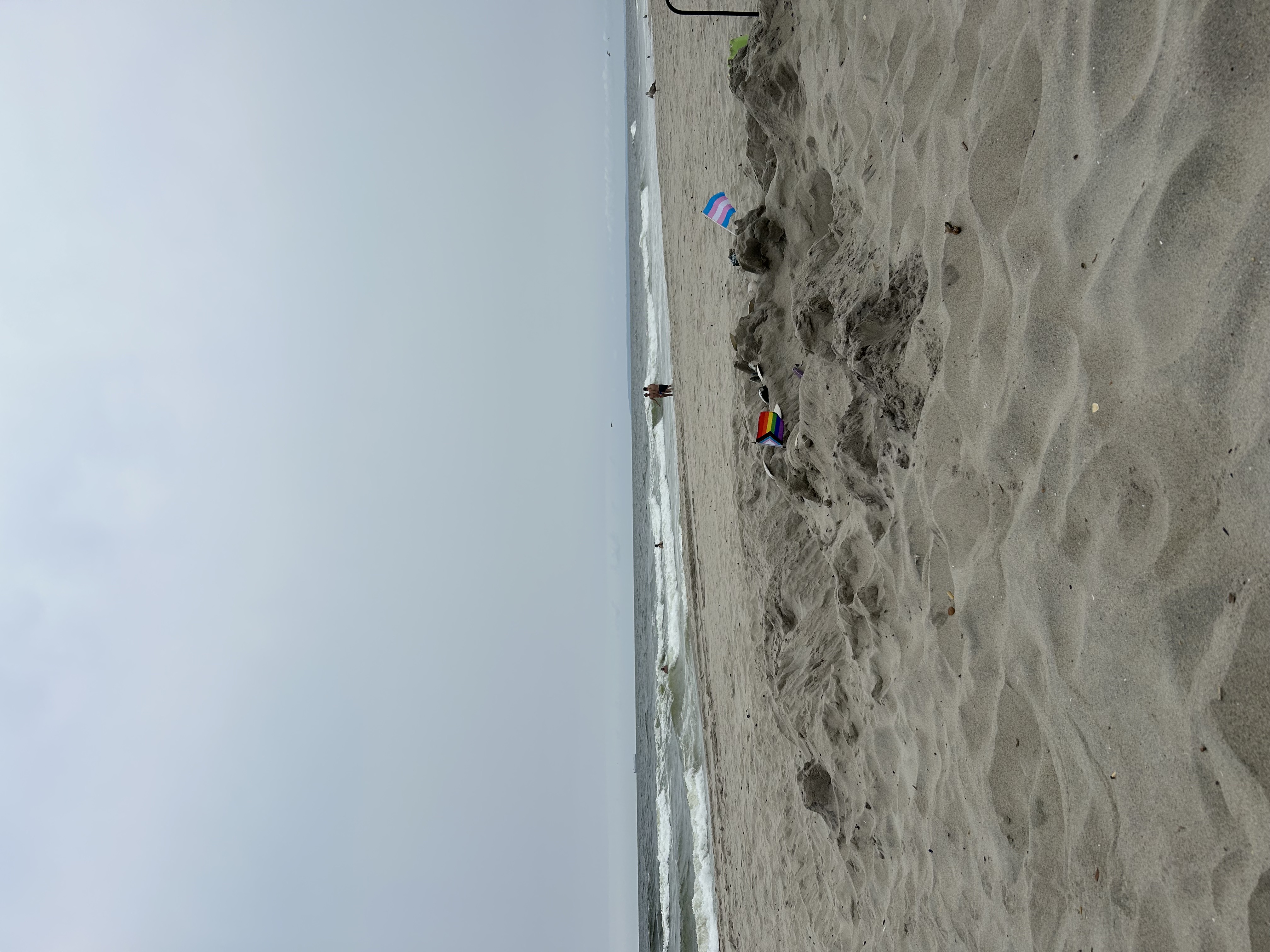
We rode the train-ferry-bus to the beach

that first summer of mine

where she lit a joint

and I floated in relief

on the stretch of sand

where my chest first met the sky.


The wobbly scaffolding of our friendship buckled

under the weight of housing horrors that crushed her,

of couch surfing stolen money landlord fuckery—

stories I did not know how to hold

as I rebuilt my life

inside the railroad apartment

with the queers from regular craigslist.


By the eruption of spring,

she disappeared down the stairs toward the 2 train

and returned to the corners of the internet

that first tethered us.

She has a new tattoo and maybe a new lover and

that is all I know now.


M. Rosenberg is a Jewish butch dyke writer and cartoonist living in Brooklyn.
She thinks about her fleeting queer friendships as intimate encounters that help us survive.
They like to write and make comics about everyday encounters with strangers and neighbors, queer survival, and what makes a “good life” in NYC.



Image: 

The Price of Freedom, or Sugar for the Revolution

by Anastasia


More than a decade ago I met with Sonja Franeta in Odessa, when she was traveling
from Turkey. I remember we talked about Marina Tsvetaeva and her poetry, as well as
her novella ¨Sonechka.¨ I had already read it, more than once. I was pleasantly
surprised by our shared connection, that spiritual bond that grows between strangers
when they discover a close connection.

In my view it is impossible to contain or even pinpoint Tsvetaeva’s genius within her
lines, within her interjections, or between her line breaks, or her em dashes—in my view
it is not possible. But…

¨Marina, will you love me always, because soon I will die…¨

I am one of those passersby she turns to:

Do not just stand there gloomily,

With your head down to your chest

Think of me tenderly

And forget me tenderly.

This is tenderly close… to her view of the world?

At that same time, in Odessa, I also got to know Olga Gert [Olgerta Kharitonova], editor
of the radical feminist journal Ostrov [Island]. Even then I could see how all these
islands intersected and resonated with one another—Tsvetaeva´s island, the Story of
Sonechka itself which she finished writing “at the ocean”—nothing like it have I ever
read to this day—and the world of that self-published samizdat journal for women
[Ostrov]. There was never anything like it nor will there be. These two parallel universes
crossed in one space thanks to the act of deep regard, including within oneself
(remaining true to oneself).

And now, in these times––times of war, of immense changes, of unbearable suffering
for so many––this love found in this writing is like sugar during the revolution. Existing
amidst the very harshness of life, the drabness, the cruelty––then and now. We could
indeed survive without it—but life is just impossible. This sugar is a pure miracle, a pure
emotion. Clearly, this emotion makes us human.

It is a love that is born of joy and a freedom to love for the sake of love––for the love of
beauty. That kind of romantic love, that love goes against terror. It is a form of rebellion
[a bunt] against the drab rules and narratives that bind us during wartime.

And, of course, the right to choose who to love and about whom to write is a creative
freedom and poetic license that is the poet´s prerogative. In Shakespeare´s [King Lear]
choosing “salt” against a love devoid of choice, is a rational love. But [Cordelia´s] choie
was an emotional and abundant love. Without which there is no joy or fullness of life.
This is my choice too.

I write these lines in gratitude for my meeting with Sonja Franeta and Olgerta.

“But where is Sonechka? Sonechka is so close—just outside the door;”

Purchase the Sapphic Classic today A Dove Under My Hand


Continue reading more on the Sinister Wisdom Blog!

Image: 
Subscribe to RSS - Mel's blog

"Empowerment comes from ideas."

Gloria Anzaldúa

“And the metaphorical lenses we choose are crucial, having the power to magnify, create better focus, and correct our vision.”
― Charlene Carruthers

"Your silence will not protect you."

Audre Lorde

“It’s revolutionary to connect with love”
— Tourmaline

"Gender is the poetry each of us makes out of the language we are taught."

― Leslie Feinberg

“The problem with the use of language of Revolution without praxis is that it promises to change everything while keeping everything the same. “
— Leila Raven