





Sinister Wisdom Newsletter
Login (ONLY for SW staff)


Margaret Cavendish: The Mother of Science Fiction
by Rivaa Ubrani
‘the thrice noble, illustrious, and excellent princess Duchess of Newcastle’
View previous newsletters and subscribe to the Sinister Snapshot!
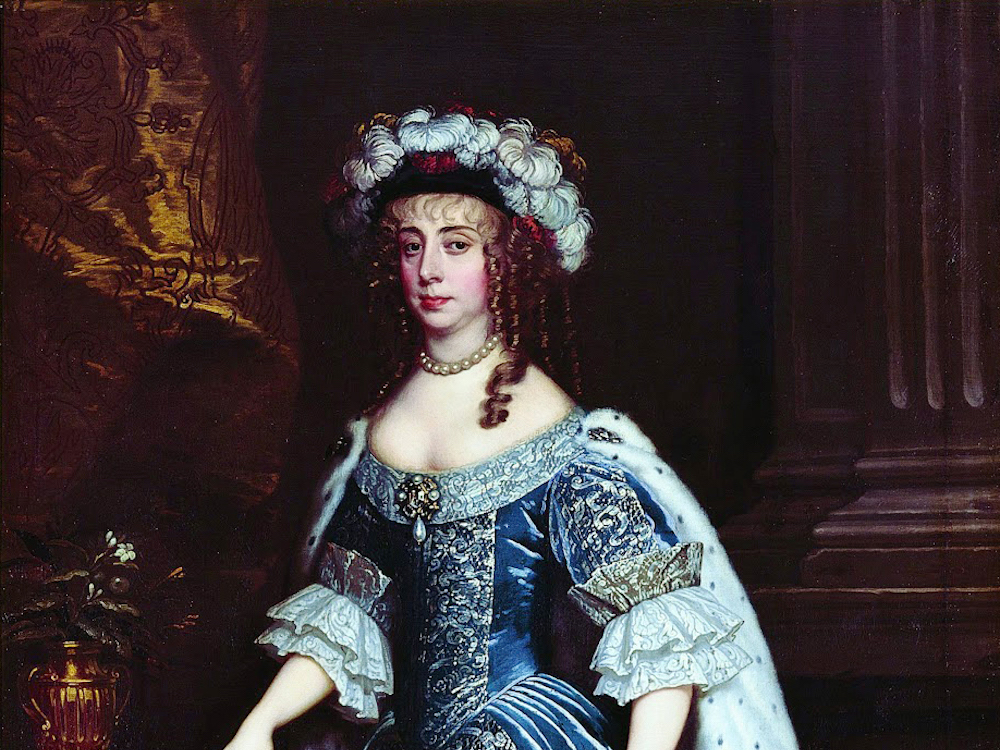
Years before Ursula K LeGuin’s gender-bending sci-fi writing and Olivia Butler’s queer speculative futures, early modern poet, author and duchess Margaret Cavendish of Newcastle (1623-1673) was making queer worlds of her own. I stumbled upon Cavendish’s work and history in the midst of my Master’s Degree in Early Modern Literature & Shakespeare, though the Renaissance era predated any contemporary notions of homo- or hetero-sexuality, its categories of gender and sex were fluid, unfixed and constantly being contested in fiction and on the stage.
Extending the Shakespearean stage conventions of cross-dressing and intimate same-gender friendships, Margaret Cavendish prolifically described worlds of female empowerment and all-girl utopias at a time when writing, playwriting and acting were deemed to be unsavoury pastimes for women. Arriving from the French court to London in 1660, Cavendish was notorious within English elite and courtly circles for her eccentric and fabulous way of holding herself. Before even putting her pen to paper, she turned her body into a readable manifesto, wearing self-designed and ‘scandalous’ gowns proudly. In a culture that prized female modesty, she styled herself as a scandal in silk and even earned the diminutive nickname of ‘Mad Madge’ for her boldness.
How very scandalous?
Where Cavendish really made a name for herself, though, was with her fictional and non-fiction literary explorations. The Duchess saturated her writings with intense female relationships: admiration, devotion, intellectual communion, and erotic possibility that never quite settle into heterosexual expectation. Her letters and poems teem with passionate addresses to women; her female characters often love other women with a tenderness that exceeds conventional friendship. Foreshadowing the intimacy of her literary predecessors Virgina Woolf and Vita Sackville-West, Cavendish writes to one of her friends:
‘the truth is, my mind and thoughts live always with you, although my person is at distance from you (..) my Soul will attend you when my Body lies in the grave; and when we are both dead, we may hope to have a Conversation of Souls, where yours and mine will be doubly united’
In this sense, she is a forerunner of later lesbian literary traditions—not by modern identity labels, but by emotional architecture.
Her most outstanding work is her science-fiction romance The Blazing World (1666). Written before both science fiction as a genre and queerness as a way of life could even be conceived of, The Blazing World depicts a female-led universe ruled by an empress and her best friend. Ruling thus amongst a cast of genderless man-animal hybrids, Cavendish’s duo test the boundaries of knowledge itself, becoming immaterial spirits and entering into spheres of political, philosophical and geographical tension—areas of knowledge denied to women at the time.
Today, Cavendish invites us to think of queerness not only as sexuality, but as a way of being in the world—imaginative, unruly, speculative, and embodied. She reminds us that lesbian lineage is not only about who slept with whom, but about who dared to dream otherwise.
Read The Blazing World for free online: link
Where to read Cavendish’s other works: http://digitalcavendish.org/complete-works/
Rivaa Ubrani (she/her) is an Indian poet, editor and aspiring children's book author, based in London, where she is pursuing an MA in Shakespeare Studies and interning at Sinister Wisdom. Her work often traces the intersections of mental illness, myth and the hyperreal.
Continue reading the Featurette on the Sinister Wisdom Blog!
"Empowerment comes from ideas."
― Charlene Carruthers
"Your silence will not protect you."
— Tourmaline
"Gender is the poetry each of us makes out of the language we are taught."
— Leila Raven
Add new comment