Dyke Bar* History: Butch-Femme in NYC’s Greenwich Village, 1940s-1960s
Jack Jen Gieseking with Michaela Hayes and Mel Whitesell
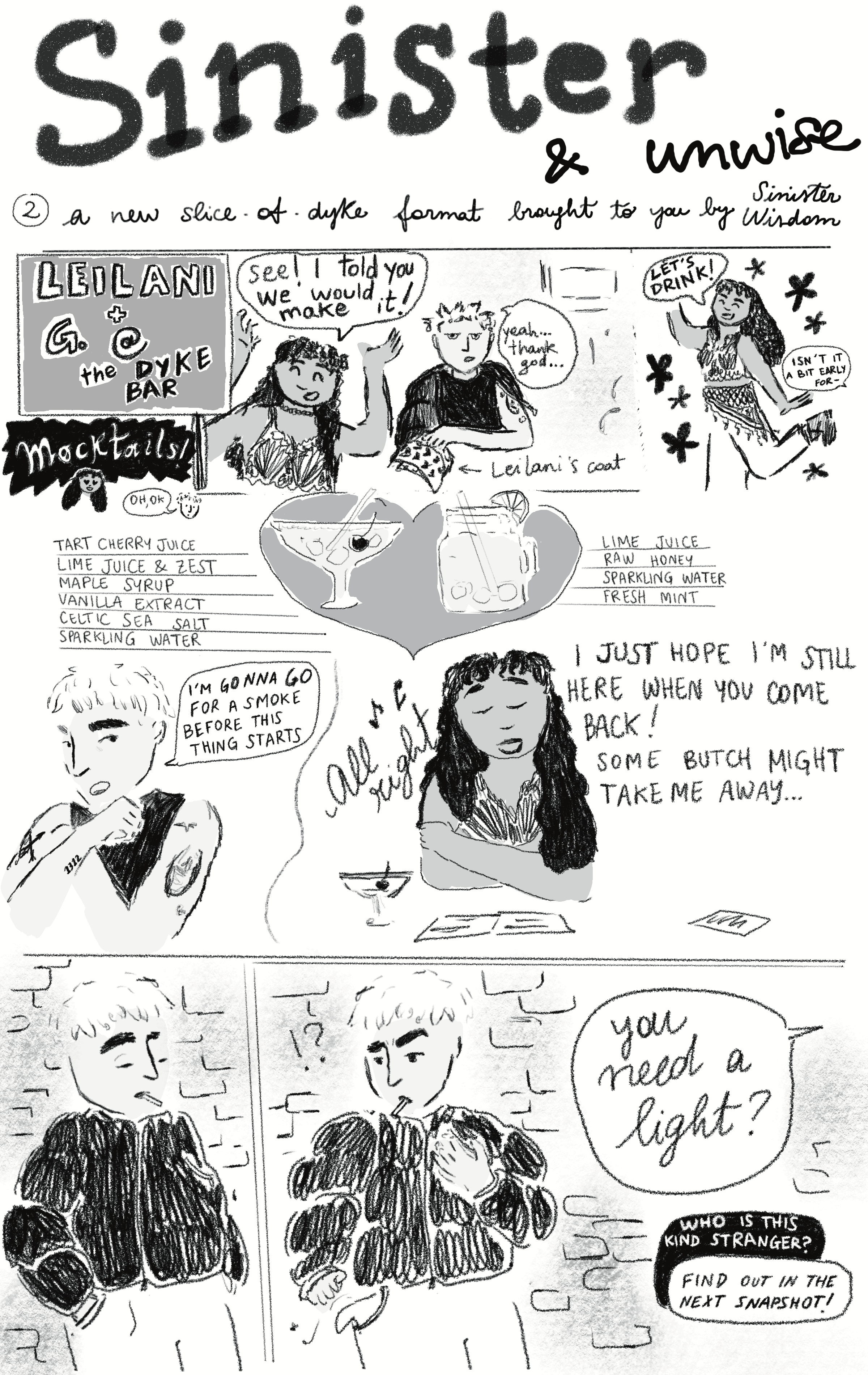
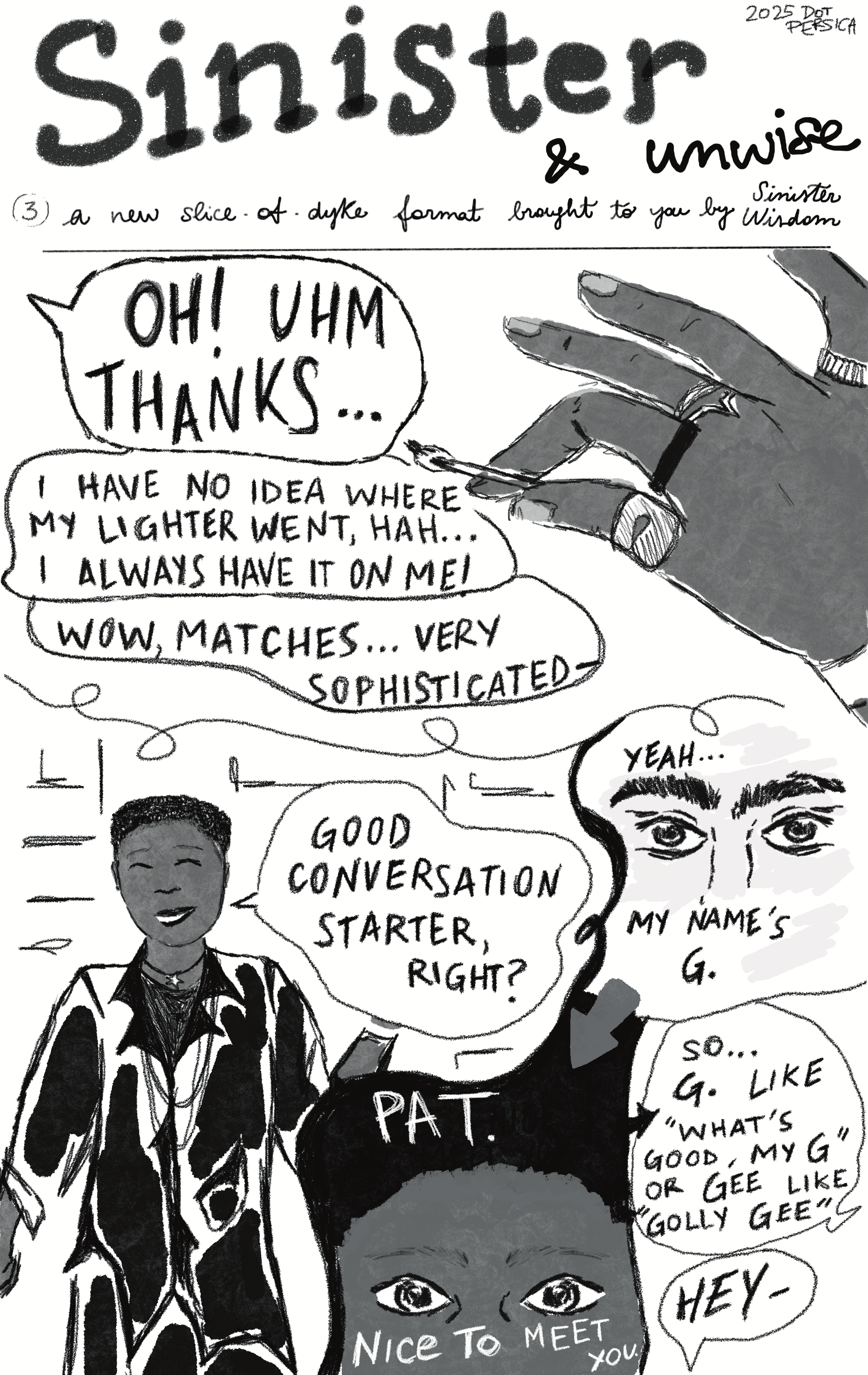
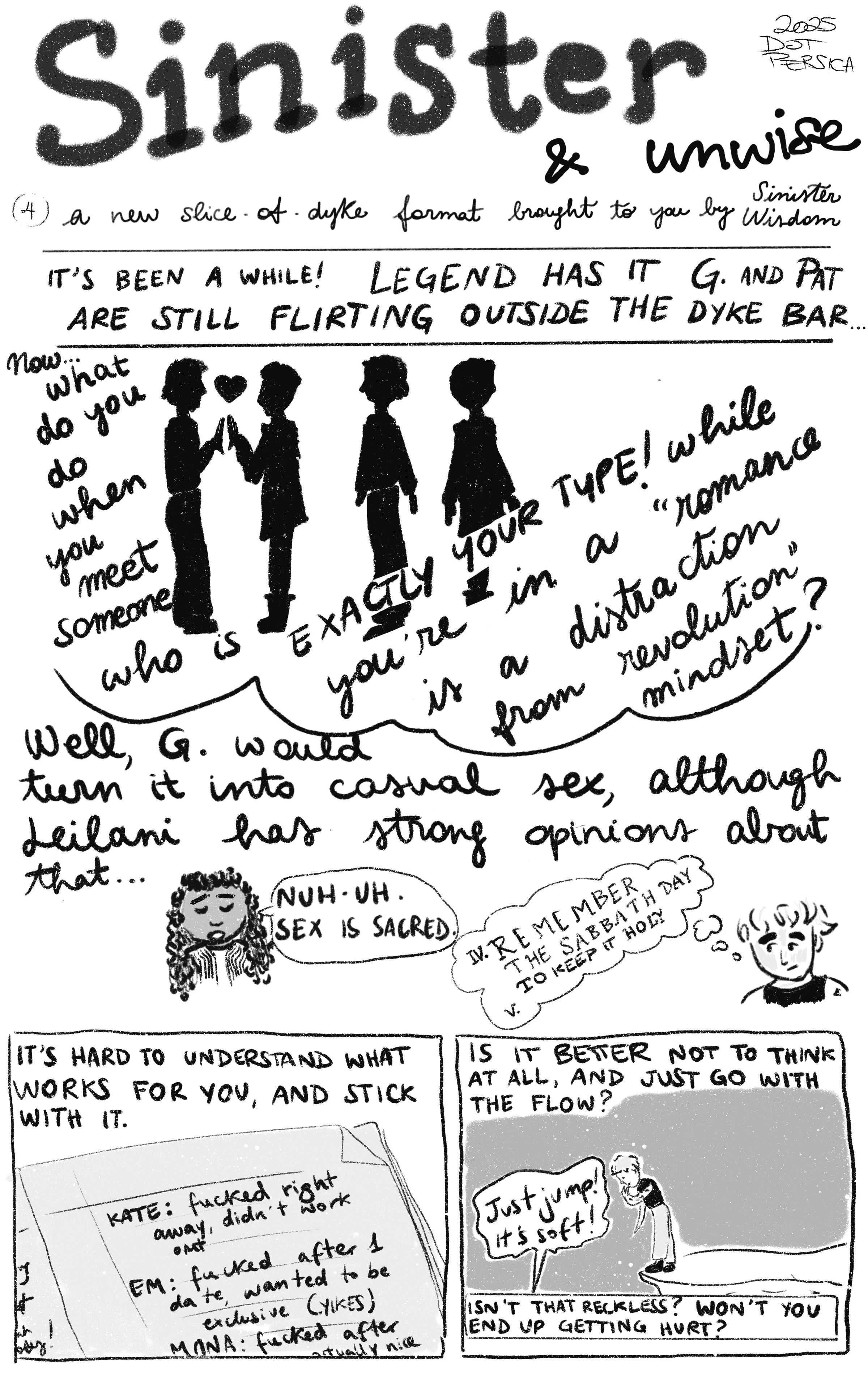
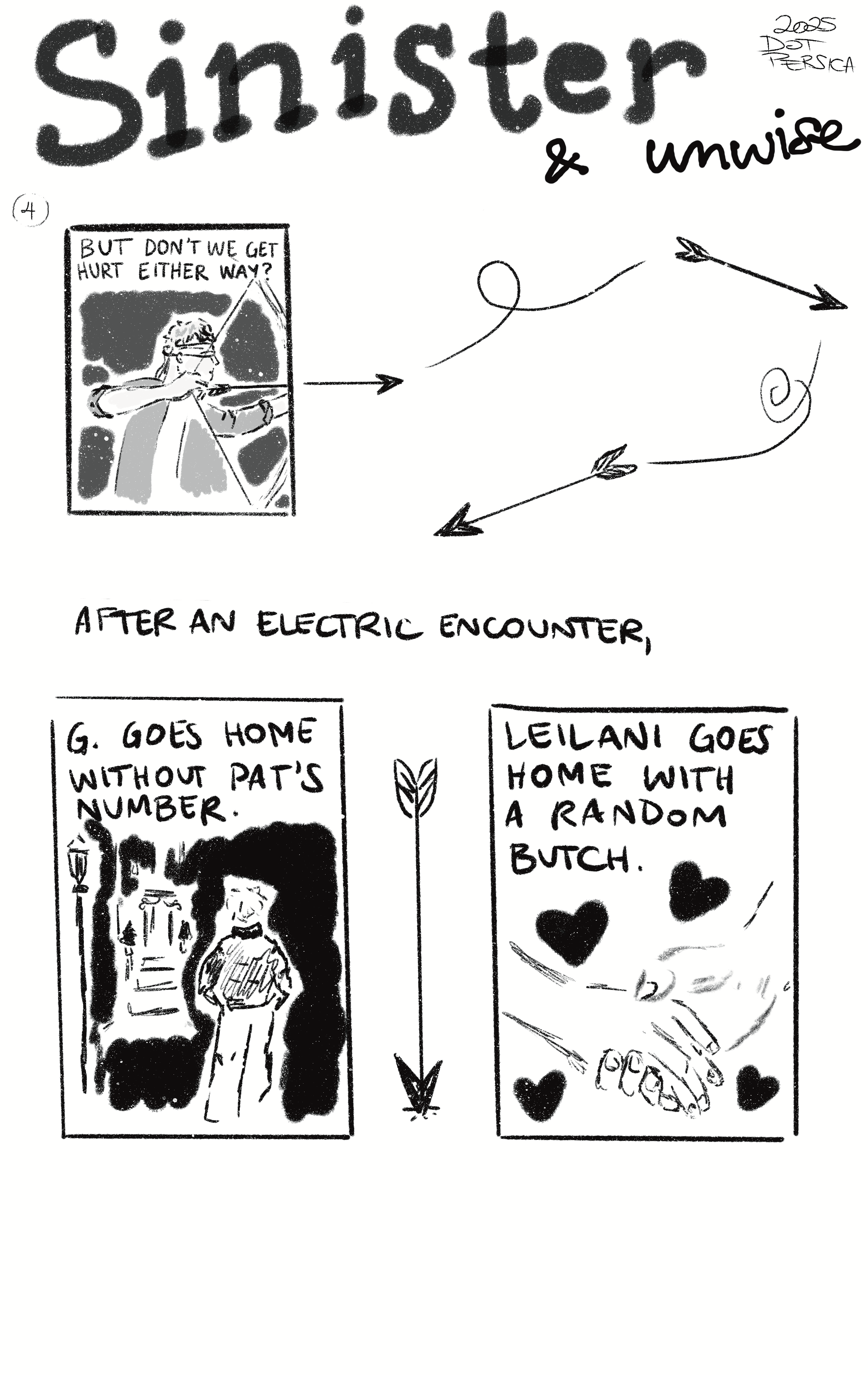
To complement the launch of theOur Dyke Histories podcast, hosted by Jack Gieseking and co-produced in collaboration with Sinister Wisdom, we’re sharing a reading guide for the decades. For the first season, Our Dyke Histories is spotlighting dyke bars*: lesbian bars, queer parties, and trans hangouts; the structures that made them necessary, the lives they made possible, and the worlds we built from them. This is the second part in a series, with the first part covering the 1920s-1930s!!
Alix Genter. “Appearances Can Be Deceiving: Butch-Femme Fashion and Queer Legibility in New York City, 1945–1969.” Feminist Studies(42)3, 2016, 604–31.
Is a butch always a butch, a fem always a fem? Who knows! But it’s sure as heck clear that what we thought was a butch or a femme in the 1950s was not always the same thing. We’re guessing you need more of an example like we did, so meet Sunny and Doris, and Miriam and May. Cutie patooties! And everyone but Sunny identified as butch.
Our collective minds were blown wide by this. And delighted! Look how wide and rangey and possible gender was and still is!
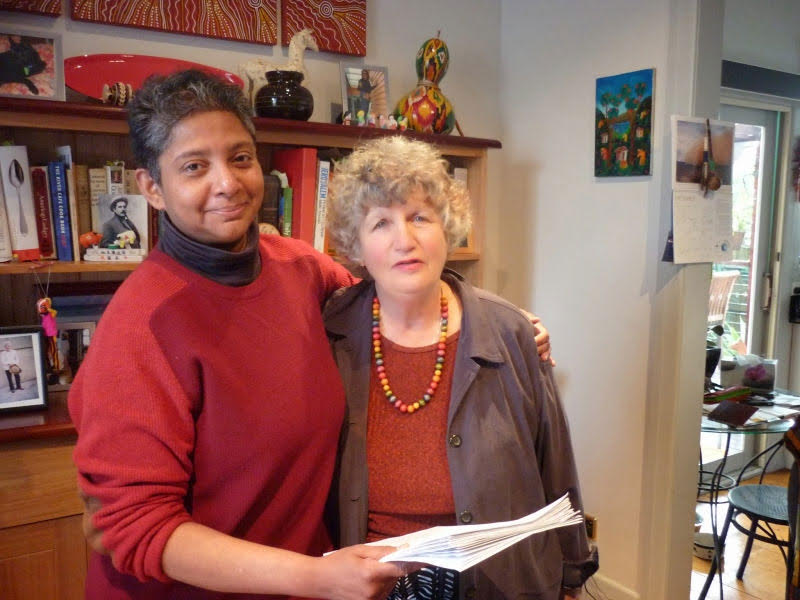
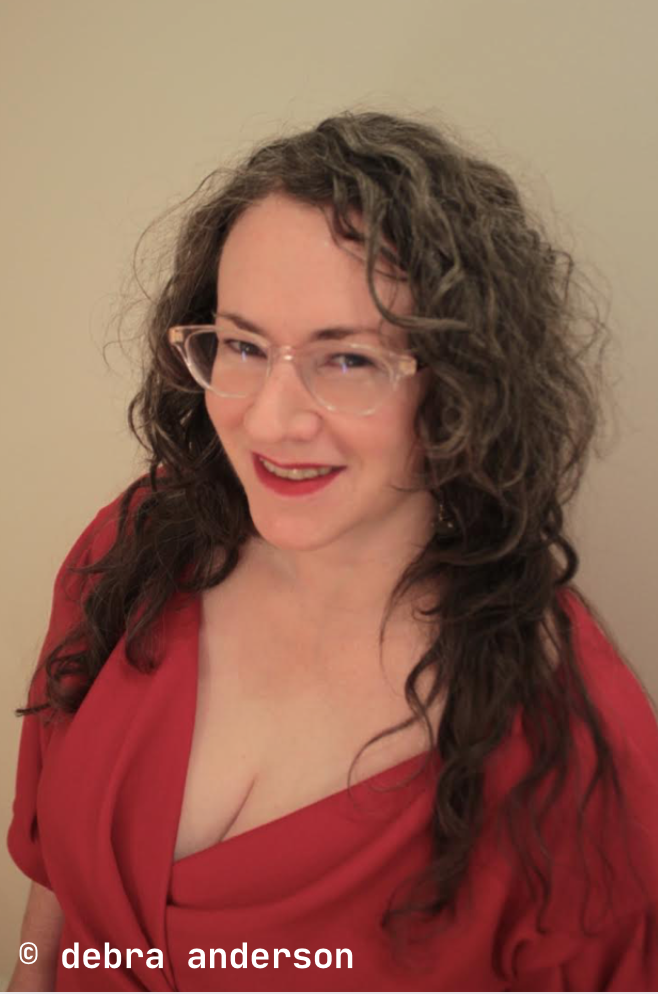
Alix Genter spent years collecting oral histories from New York City dykes in the post-WWII period, including Lesbian Herstory Archives originator and co-founder Joan Nestle (wow and swoon forever–see her photo on the left) and a swarm of other well-known dykes of the period. In her article, she digs into butch self-making to show us that butches were never (so boring as to be) imitating cis-het men’s masculinity, rather butches circumvented or even adapted feminine dress styles to convey their gender nonconformity. Genter shows how butch presentations varied between straight and queer spaces, with lesbian bars and other queer nightlife locales being essential sites of gender construction, expression, and butch mentoring.
Across race, class, and ranges of masculine signification, Genter encapsulates the flexibility of butch identity at a time when gender variance was a dangerous expression of visible queerness. And, wow, were our hearts and loins inspired by her work. We also deeply recommend her entire dissertation, Risking Everything for That Touch, available here for free and with many more delicious images and tales of mid-century lezbiqueertrans lives. Desire and danger to the max.
Images:
Alix Genter, “Appearances Can Be Deceiving- Butch-Femme Fashion and Queer Legibility in New York City, 1945–1969,” Feminist Studies, Vol. 42, No. 3 (2016), pgs. 604-631
Dyke Bar* History: Leslie Feinberg in Buffalo, 1960s
Jack Jen Gieseking with Michaela Hayes and Mel Whitesell
To complement the launch of theOur Dyke Histories podcast, hosted by Jack Gieseking and co-produced in collaboration with Sinister Wisdom, we’re sharing a reading guide for the decades. For the first season, Our Dyke Histories is spotlighting dyke bars*: lesbian bars, queer parties, and trans hangouts; the structures that made them necessary, the lives they made possible, and the worlds we built from them. This is the second part in a series, with the first part covering the 1920s-1930s!!
Feinberg, Leslie. Stone Butch Blues. Ithaca: Firebrand Books, 1993.
Being pointed to Leslie Feinberg’s Stone Butch Blues as a young and/or recently out lez, bi, queer, trans, or sapphic person is as much a dyke trope as running into an ex-flame at the bar or fighting the urge to U-Haul after the first date (or second or third…).
And you know why it’s a trope? Because it’s fucking amazing and, yes, we are telling you to go read this book.
Feinberg’s perfectly devastating and epically beautiful novel follows Jess Goldberg, a working-class, stone butch lesbian-cum-trans man, through childhood into adulthood in New York. Throughout the book, the dyke bar serves as an important backdrop in Jess’s life. In Buffalo, it’s a place where Jess navigates growing up, finding queer community, gender exploration, heartbreak, and romance while facing violence at the hands of the state and police. In adulthood, New York City dyke bars become a place where Jess can reconnect with old friends and–wait for it, my trans friends and countryqueers–apologize to a butch friend for not respecting her butch4butch relationship in the past. Feinberg/Jess are classy shes/hes/zes, I tell you. Though fictional, Feinberg’s intimate book explores classism, racism, anti-semtisim, sexual violence, homophobia, and transphobia that were a reality for butches, trans mascs, and gender non-conforming dykes in the late 20th century–and still today.
We admit that Stone Butch Blues is occasionally a difficult read due to the graphic nature of the many different forms of violence Jess endures. Make sure you have some tissues handy. Ultimately though, this book is a classic we keep handing down–like Audre Lorde’s Zami and editor Cherríe Moraga and Gloria E. Anzaldúa’s This Bridge Called My Back: Writings by Radical Women of Color–because it carries both historical and present eternal lives. Whenever you’re ready to read it, please remember to tell the next dyke you meet to read it too.
Dyke Bar* History: Audre Lorde in NYC’s Greenwich Village, 1950s-1960s
Jack Jen Gieseking with Michaela Hayes and Mel Whitesell
To complement the launch of theOur Dyke Histories podcast, hosted by Jack Gieseking and co-produced in collaboration with Sinister Wisdom, we’re sharing a reading guide for the decades. For the first season, Our Dyke Histories is spotlighting dyke bars*: lesbian bars, queer parties, and trans hangouts; the structures that made them necessary, the lives they made possible, and the worlds we built from them. This is the second part in a series, with the first part covering the 1920s-1930s!!
It’s safe to say that all dyke roads can and should lead back to the queen of wisdom, insight, calling in, and brilliance: Audre Lorde. Best known for her leadership, activism, poetry, and essays–including “The Master’s Tools Will Never Dismantle to Master’s House,” Black lesbian and feminist Lorde is also one of the key sources for personal stories of 1950s lesbian bars and queer parties. She was a long, steady customer at the Bagatelle or “the Bag” in Greenwich Village, New York City, one of the many mafia-owned and -run working-class, butch-femme bars that inspired mid-century queer pulp alongside our current lez bar imaginaries. Through her positionality, experiences, and theorizations in her mythoautobiography–a term Lorde invented for her semi-fictionalized autobiography or what we now often call creative nonfiction–she shares the struggles and realizations that still shape queer, feminist, BIPOC, and Black lives. These include severe ups and downs in bar life, and all of which led her to her brilliant ideas she left behind for us to grow from and in.
First, let’s be up about the worst of it as Lorde was. Most of the bar patrons were white butch-femme, and working-class, and a white aesthetic, culture, and attitude dominated the space. The racial segregation of lesbian bars, unlike other spaces, was not discussed between white and Black or even among Black lesbians, but was clearly visible. Lorde wrote:
The Black gay-girls in the Village gay bars of the fifties knew each other's names, but we seldom looked into each other's Black eyes, lest we see our own aloneness and our own blunted power mirrored in the pursuit of darkness. Some of us died inside the gaps between the mirrors and those turned-away eyes. … Being women together was not enough. We were different. Being gay-girls together was not enough. We were different. Being Black together was not enough. We were different. Being Black women together was not enough. We were different. Being Black dykes together was not enough. We were different.
The ache is profound. It was the structures of oppression within and inside the bar that perpetrated this hurt. Bartenders, owners, staff, and some patrons openly discriminated against BIPOC, even as they knew that they had so few spaces to share as lesbians.
But the positives of lesbian bars kept bringing Lorde back. She writes, “What we both needed was the atmosphere of other lesbians, and in 1954, gay bars were the only meeting places we knew.” While antiracism was a nascent concept at best in the 1950s U.S., it’s fledging moments are sometimes found in or as a result of dyke bars* as queer sexualities forced groups of people together across race and class lines who would otherwise never had the chance to meet together. As Lorde puts it so beautifully: “We met women with whom we would've had no other contact had we not all been gay.” She later adds, “Lesbians were probably the only Black and white women in New York City in the fifties who were making any real attempt to communicate with each other; we learned lessons from each other, the values of which were not lessened by what we did not learn.” Wow.
We will not be revealing the end, clearly, because you must read this book! (Truly, we devoured it for the first time or tenth time in a few days.) But in the end, we can reveal, Lorde lands in theorizing how we can and must connect across difference:
It was a while before we came to realize that our place was the very house of difference rather than the security of one particular difference. (And often, we were cowards in our learning.) It was years before we learned to use the strength that daily surviving can bring, years before we learned fear does not have to incapacitate, and that we could appreciate each other on terms not necessarily our own.
It’s amazing how much dyke bars* informed Lorde’s life–and ours still!--and these generous, insightful words. If you need more Lorde, she wrote oodles or you can the recent and fabulous biography of Lorde from Alexis Pauline Gumbs, Survival Is a Promise: The Eternal Life of Audre Lorde (2025). It’s what we’re reading to feed our holidays with delight.
Dyke Bar* History: Mona’s Candle Light in San Francisco, 1950
Jack Jen Gieseking with Michaela Hayes and Mel Whitesell
To complement the launch of theOur Dyke Histories podcast, hosted by Jack Gieseking and co-produced in collaboration with Sinister Wisdom, we’re sharing a reading guide for the decades. For the first season, Our Dyke Histories is spotlighting dyke bars*: lesbian bars, queer parties, and trans hangouts; the structures that made them necessary, the lives they made possible, and the worlds we built from them. This is the second part in a series, with the first part covering the 1920s-1930s!!
Where would dykes be without blurry amateur films and gender fuckery?
Discovered amid rolls of unmarked film at a flea market, Mona’s Candle Light is a testament to the power of the archive, transporting viewers to a hazy evening at the legendary lesbian nightclub for just six ephemeral minutes.
Mona Sargent deserves to be a bigger name in the dyke world – in the 1940s she cornered the market on San Francisco’s lesbian nightclubs and drag events, bringing queer culture to the “bohemians” while still cultivating some of the earliest lesbian community spaces. (Read more about the history here or listen to an entire episode of the Cruising Pod podcast with actual archival audio with Mona herself).
As the video begins, neon signs blink against the night sky until the camera lands on one that reads “Mona’s Candle Light” – femme lounge singer Jan Janssen comes into focus, spotlighted onstage in a corner of the shadowy room. Introduced by drag king Jimmy Reynard, she performs two songs while apathetic straight couples watch from the audience (this is my one complaint: where are the dykes? These people don’t even know how lucky they are!).
Mona’s stayed open for decades in various forms since 1935, making it one of the oldest and longest-running lesbian bars in the country. It hosted the famous and fabulous Gladys Bentley and other so-called “gender impersonators” as a form of racial and sexual tourism, per historian Nan Boyd’s Wide-Open Town: A History of Queer San Francisco to 1965, the definitive history of LGBTQ+ San Francisco. Along with her in-depth oral histories of people like Mona herself and regulars like Reba Hudson, Boyd collected a series of photos of Mona’s which the GLBT Historical Society of San Francisco has made public. Swoon.
Back to the documentary, this invaluable footage makes your queer/trans bodymind feel invaluable and loveable too, even to witness it. It’s a cinematic candle illuminating the darkness of the lesbian underground scene. As dyke bars across the country disappear, it’s powerful to witness this fragment of queer history – every city deserves a place like Mona’s, “where girls will be boys!”
Jack Jen Gieseking with Michaela Hayes and Mel Whitesell
To complement the launch of theOur Dyke Histories podcast, hosted by Jack Gieseking and co-produced in collaboration with Sinister Wisdom, we’re sharing a reading guide for the decades. For the first season, Our Dyke Histories is spotlighting dyke bars*: lesbian bars, queer parties, and trans hangouts; the structures that made them necessary, the lives they made possible, and the worlds we built from them. This is the second part in a series, with the first part covering the 1920s-1930s!!
Lo, Malinda. Last Night at the Telegraph Club and Scatter of Light. New York: Dutton Books for Young Readers, 2021, 2022.
Last Night at the Telegraph Club is the ultimate queer YA novel: it’s mature enough to enjoy as an adult while still speaking directly to your (gay and scared) inner teenager, while simultaneously offering itself as a genuine place of solace for young people who might be struggling to understand themselves.
The book is set in 1950s San Francisco Chinatown and follows 17-year-old Lily Hu, a second-generation Chinese-American trying to navigate life as a “good Chinese girl” as she realizes she’s falling in love with her classmate Kath. Kath and Lily soon venture to the secret-not-secret lesbian bar The Telegraph Club, where they find refuge, find themselves, and find each other. While Last Night can be a beach read, company for your public transport (who among us hasn’t cried over a novel on the bus?), or something to tuck you in at night, it’s fair to say that the intensity of the scenes gives you a hint of what the 1950s felt like for LGBTQ+ people, especially Asian lesbians. (Of note: there’s still remarkably less literature on Asian and Asian-American lesbians, so check out Sinister Wisdom’s special issue 120: Asian Lesbians).
We also devoured Malinda Lo’s blog series “Notes from the Telegraph Club”, where she discusses the incredible research she did for the novel. Our absolute favorite is “The True Story of a Raid on Tommy’s Place” – it’s everything you imagine dykes had to live through in the 1950s but, well, real. There’s even photos of folks like Grace Miller, Joyce Van de Veer, and possibly Jeanne Sullivan at bar. Lo writes:
That Wednesday night at nine p.m., what could have been a comfortable, casual weeknight with friends at the local bar abruptly changed. San Francisco police arrived bearing warrants for two of the bar’s owners—Miller and Van de Veer—who were charged with contributing to the delinquency of minors by serving them alcohol. The bar’s patrons were told to leave, which they probably did as quickly as possible, plunging into the night and hurrying away from the neon-lit intersection of Broadway and Columbus.
Meanwhile, the police conducted a search of the premises and claimed to find a heroin kit hidden in the restroom at 12 Adler. Miller and Van de Veer were arrested, and the next day San Francisco’s newspapers printed photos of the two being charged, along with their home addresses. In the San Francisco Examiner image, both women have short hair and wear blazers, and though they must have been afraid, they look nonchalant, even a little annoyed that their night had been interrupted.
Now, you get it! Woah.
Two of us teared up multiple times reading Lo’s books (ages 26 and 46, respectively), and also felt so freed by how much the dykes of our past did for us. And we laughed at times too, to see such consistent sagas of dykedom (but does she like me?!?!!?) reflected back at so many decades later.
We equally endorse the follow up novel, Scatter of Light, but we’ll save the spoilers and just tell you our dear Lily keeps on queering up the West Coast. Both of Lo’s books help us dive in to go back in time to the 1950s, and remind us to keep fighting like hell for the living we are doing today.
Malinda Lo website https://www.malindalo.com/
Image Credit: Grace Miller, Joyce Van de Veer, and possibly Jeanne Sullivan at bar. SAN FRANCISCO HISTORY CENTER, SAN FRANCISCO PUBLIC LIBRARY
Dyke Bar* History: The Beebo Brinker Chronicles, 1957-1962
Jack Jen Gieseking with Michaela Hayes and Mel Whitesell
To complement the launch of theOur Dyke Histories podcast, hosted by Jack Gieseking and co-produced in collaboration with Sinister Wisdom, we’re sharing a reading guide for the decades. For the first season, Our Dyke Histories is spotlighting dyke bars*: lesbian bars, queer parties, and trans hangouts; the structures that made them necessary, the lives they made possible, and the worlds we built from them. This is the second part in a series, with the first part covering the 1920s-1930s!!
Bannon, Ann. Beebo Brinker. New York: Gold Medal Press, 1962.
Meet Beebo Brinker, the most popular book of The Beebo Brinker Chronicles, a six-part lesbian pulp series (1957-1962), a.k.a. the super sexy dime store novels of the mid-20th century where the queers usually die…but(!) Beebo doesn’t. Bannon writes of the iconic, tall, hot, mildly-unhinged Beebo as she tries to make a life for herself in late 1950s Greenwich Village, New York City. After being chased out of her conservative Midwestern hometown at only 18 for cross-dressing at a fair, Beebo turns her humble beginnings on their head.
Our hero Beebo wastes no time becoming the hottest butch in the city, aided initially by a semi-closeted gay man who takes her to The Colophon, her first lesbian bar. While the Colophon is where she has her official gay awakening, it is not the central point of her gay chaos. Rather, it is her status as “pizza delivery dyke”--a perfect turn of phrase penned by Autostraddle’s own Kayla Kumari Upadhyaya. Through her pizza delivery job, Beebo meets 1) her sexy archnemesis, Mona, 2) her will-they won’t-they lover Paula, and 3) her tragically unattainable movie-star girlfriend Venus Bogardus. Throughout all this, The Colophon shimmers behind the scenes as the catalyst into Beebo’s self-acceptance and ensuing queer chaos.
Dyke Bar* History as Told by Beebo, Lily, Audre, Leslie, Alix, & Mona: 1940s-1960s
Jack Jen Gieseking with Michaela Hayes and Mel Whitesell
To complement the launch of theOur Dyke Histories podcast, hosted by Jack Gieseking and co-produced in collaboration with Sinister Wisdom, we’re sharing a reading guide for the decades. For the first season, Our Dyke Histories is spotlighting dyke bars*: lesbian bars, queer parties, and trans hangouts; the structures that made them necessary, the lives they made possible, and the worlds we built from them. This is the second part in a series, with the first part covering the 1920s-1930s!!
While the 1920s and 1930s were all about queer women slipping in and out of smoky speakeasies and tea rooms with monocles and bad gin, that radically shifted by the mid-20th century. The 1940s through 1960s turned the volume way up on danger, desire, and dyke ingenuity.
World War II moved women into military bases, shipyards, and cities, suddenly offering networks of possibility that, once the war ended, was often economically kaput but psychologically and socially forever. On (and in) the heels of Prohibition, “gender impersonator” acts continued to bring trans, nb, drag, and genderqueer presences to stages and audiences in urban bars across the country–all the while trans and gender non-conforming people were targeted for being themselves. While parties continued to thrive underground, the public lesbian bars became a beacon in this era: part sanctuary, part battleground, and always a little bit messy.
Basically, if you’ve ever locked eyes with a hot stud/butch/masc/nb across a sticky bar floor and thought, “This is dangerous but worth it,” lift a toast to this era and the dykes who survived it. The period from the 1940s through the 1960s gave us the blueprint for dyke drama, bar crushes, messy hookups, police raids, and the complicated joy of finding each other in the dark. So next time you’re two bevvies deep (of course, seltzers count) and arguing about whether flannel is a lifestyle or a symptom, remember: Leslie Feinberg walked tall so you can too.
From San Francisco’s lesbian-trans bar Mona’s Candle Light (immortalized in a grainy six-minute film clip that still makes our hearts pound) to Greenwich Village’s fictional Colophon (for Beebo Brinker) and real life Sea Colony (and the very real Joan Nestle and friends), lesbian bars promised the intoxicating mix of safety, sex, and chaos. Inside, femmes dazzled in pin curls, heels, and pencil skirts, butches swaggered in leather jackets or collared shirts with a firm duck’s ass (see left), and gender impersonators made chanteuses faint in the bright light of the stage. Outside, police wagons waited to raid, arrest, and humiliate. This contradiction—the thrill of self-discovery and the constant threat of violence—was the air lesbians, queers, and gender rebels were forced to breathe daily.
Mandy Wallace’s piece “Plantinting” (fig.1) glows off the pages of the third issue of Sinister Wisdom, published in 1977. The soft, pale figure in the center of the piece emits light along with the moon, and the tiny, sporadic stars in the night sky that almost seem pimply. She kneels on a field that mimics a vulvic or mammillary form, weaving humanity and nature in its shapes. The figure holds a gardening rake that rests on her shoulder, as the other hand loosely drops seeds into the soil. In the distance, a small house and tree sit atop a hill, reminiscent of the painting, “Christinas World” by Andrew Wyeth. In scrawled cursive, “Plantinting,” the misspelling of “planting” is written. Mandy Wallace said, “It was a mistake, but I like mistakes. I have a lot of respect for accidents.”
Wallace was born in Tuscaloosa, Alabama and lived in Charlotte, North Carolina, a possible influence for the atmosphere and geographical setting of this piece. During her time in Charlotte, she studied with writer Bertha Harris at UNC Charlotte and met Catherine Nicholson. Through Catherine, Wallace would learn of a women’s center starting up in town. There she would meet Harriet Desmoines, who, with Catherine Nicholson founded Sinister Wisdom. Wallace said, “So, I started showing up there, and there was a group of lesbians who wanted to talk about lesbian theory. We decided to form a Separatist group and call ourselves Drastic Dykes.”
In that group, Mandy met a friend who spent a summer on a “Back to the Land” farm. This was a part of what inspired Mandy to create “Plantinting.” She said that it felt sentimental and romantic. The piece was formally inspired by the 15th Century Book of Hours of Jean, Duke de Berry. Mandy said, “…It was illustrations for a prayer book and very much tied to the seasons…The sort of idealist form, the arch, the stars in the sky being so ordered, the formalized, stylist, landscape, it was inspired a lot by that.” When asked what the figure was planting, Wallace said, “My first thought was probably some okra and some marijuana.”
Figure 2.
Similar styles and themes can be seen in her other works published in Sinister Wisdom. In the first issue of Sinister Wisdom, published in 1976, her work (fig. 2) reads in her previously seen cursive, “the beast, disguised as nurse, takes the daughter.” It depicts a human form lying on a bed, their limbs bent in unnatural ways. On the figures arm, the letter “A” can be seen which implies “Amazon.” Behind the figure on the bed, in the doorway, is a small, unsettling looking creature in a classic nurse’s uniform holding what looks to be a swaddled newborn in its arms. The piece was inspired by a mythological story that Harriet Desmoines told Wallace about a beast taking a daughter and a news article about a nurse who stole a newborn from the hospital. In Sinister Wisdom 4, published in 1977, her work (fig. 3) is featured on the cover. She did illustrations for “Ket Meets the Dragon” By Joanna Russ (fig. 4 and 5), which explores more naturistic themes. In a journal entry published in the first issue of Sinister Wisdom, Wallace wrote, “…My work always has a degree of melancholia about it. ‘Nobody knows what it means. I don’t know what it means until after the fact – just like everything I do.”
Mandy Wallace now lives in California where she finds that her work is more narrative yet associative while it still holds romanticism in its style and themes. She said, “Oftentimes there’s tragedy and resolution… I work from observation more, although I compile from a lot of different sources.” She shared that she is now working on a project called “Nature Is A Lot About Eating” which seeks to capture the complexities of the cycles of life.
Check out Mandy Wallace’s work on her website (https://www.mandywallace.net) and view her past work with Sinister Wisdom on the archives page of the Sinister Wisdom website.
Isabelle Drake is a writer and poet who lives in Savannah, Georgia and has lived all around the world. She is a graduating senior at the Savannah College of Art and Design, getting her BFA in Writing. She has focused her writing and studies in feminist and lesbian topics.
Dyke Bar* History: Harlem rent parties of the 1920s and 1930s
Jack Jen Gieseking with Michaela Hayes, Mel Whitesell, Paige LeMay, Syd Guntharp, and Sarah Parsons
To complement the launch of theOur Dyke Histories podcast, hosted by Jack Gieseking and co-produced in collaboration with Sinister Wisdom, we’re sharing a reading guide for the decades. For the first season, Our Dyke Histories is spotlighting dyke bars*: lesbian bars, queer parties, and trans hangouts; the structures that made them necessary, the lives they made possible, and the worlds we built from them.
Woolner, Cookie. The Famous Lady Lovers: Black Women and Queer Desire before Stonewall. Chapel Hill: The University of North Carolina Press, 2023.
Prior to Stonewall, we’ve long known all too little about the history of Black queer women’s social networks. Of course, these women’s spaces thrived as much as white women’s spaces, and were equally daring, deeply fascinating, and terrifically important. So thank the flipping goddess that Cookie Woolner traces the lives of Black “lady lovers” from blues legends to bulldaggers, from rent parties to private salons in the 1920s and 1930s.
Woolner has every famous Black dyke of the era you’ve ever heard of, like the stud of all studs and gender outlaw, Gladys Bentley and Bessie Smith, to those lesser known powerhouses, Lucy Diggs Slowe, Howard University’s first dean of women, and all of the relationships like Ethel Wiliams and Ethel Water (The Two Ethels are a must read), struggles, advances, and even some juicy hookups between these massive networks of Black dyke.
The stories in her research are moving, inspiring, harrowing, and also sexy. We cannot help but share the incredible lyrics to Ma Rainey’s “Prove It On Me, Blues.” It’s pure fire!
It's true I wear a collar and a tie
Makes the wind blow all the while
Don't you say I do it, ain't nobody caught me
You sure got to prove it on me
Say I do it, ain't nobody caught me
Sure got to prove it on me
I went out last night with a crowd of my friends
It must've been women, 'cause I don't like no men
Woolner’s book also contains the definitive scoop on local papers would target lesbian rent parties as “dangerous to the health of all concerned” due to these fetes’ “combination of bad gin, jealous women and a carving knife.”
Woolner’s book is a powerful example of how lezbiqueertranssapphic nightlife, especially in non-white spaces, shapes itself in creative ways to survive while offering sites for queer peeps to politically organize, develop creative and literary partnerships, and socialize. A must read for Black queer history in the early 20th century.
Our key takeaway? Fixating on lesbian bar history alone leaves out BIPOC experiences, and private parties were the default for lezbiqueertrans life. We only just started to be fully public dykes in the 1930s.
Jack Jen Gieseking with Michaela Hayes, Mel Whitesell, Paige LeMay, Syd Guntharp, and Sarah Parsons
To complement the launch of theOur Dyke Histories podcast, hosted by Jack Gieseking and co-produced in collaboration with Sinister Wisdom, we’re sharing a reading guide for the decades. For the first season, Our Dyke Histories is spotlighting dyke bars*: lesbian bars, queer parties, and trans hangouts; the structures that made them necessary, the lives they made possible, and the worlds we built from them.
Georges Brassaï’s 1932 photographs of Parisian lesbian club Le Monocle are some of the most enduring images of early 20th century queer nightlife. The monocle itself—worn by masculine women in Paris and in normative-bending circles across Europe—is a specific queer visual code, a marker of gender presentation and affiliation. In other words, the monocle is the early 20th-century Parisian equivalent of the 2000s' carabiner.
The images offer a dense visual archive: Lulu de Montparnasse, the club’s owner, in tailored menswear; patrons whose postures and gazes index intimacy, ease, and self-fashioned gender; the juxtaposition of elegance and risk that characterized interwar lesbian nightlife. The most reproduced image depicts the butch athlete Violette Morris and her partner.
Morris’s life, both extraordinary and troubling: she was an Olympic-level athlete with over 50(!) medals, gender nonconformist who had a double mastectomy because she said it was thus easier to drive her racecar, and, tragically and violently, a collaborator with the Nazi regime. Morris’ life speaks to the complexity of queer history, and how we complicate and must confront the fascism of today.
Viewing the Le Monocle photographs nearly a century after they were taken, we’re struck by the similarities between patrons of Le Monocle and modern dykes. Many of us still dress to the nines to stare pensively into the distance. These photographs resonate not because they romanticize the past, but because they show a lesbian place that is recognizable: a room where dykes and trans people gather to see and be seen, to craft gendered and erotic worlds with one another.
Notably, Le Monocle lasted on for decades, a rare accomplishment for a lesbian bar. It was also a hub for sex workers and a place where working-class dykes gathered.
Paris rang all strata to its urban enclaves, like a clear bell of where to find home. Paris was brimming with wealthy lesbianism the likes of Natalie Barney’s salons, Gertrude Stein and Alice B. Toklas’ walkabouts and rideabouts, and many other many dykes. If you want to dive deeper into the historical muff of a century of lesbian Paris, we heartily recommend Tamara Chaplin’s thick and detailed Paris Becoming Lesbian: A Queer History of Modern France. And if you just want to know about the wealthy, or you too are obsessed with the birth of modernism, Diana Souhami’s No Modernism Without Lesbians is the perfect beach read.
“And the metaphorical lenses we choose are crucial, having the power to magnify, create better focus, and correct our vision.”
― Charlene Carruthers
"Your silence will not protect you."
Audre Lorde
“It’s revolutionary to connect with love”
— Tourmaline
"Gender is the poetry each of us makes out of the language we are taught."
― Leslie Feinberg
“The problem with the use of language of Revolution without praxis is that it promises to change everything while keeping everything the same. “
— Leila Raven