




Sinister Wisdom Newsletter
Login (ONLY for SW staff)


Review of The Backwater Sermons by Jay Hulme
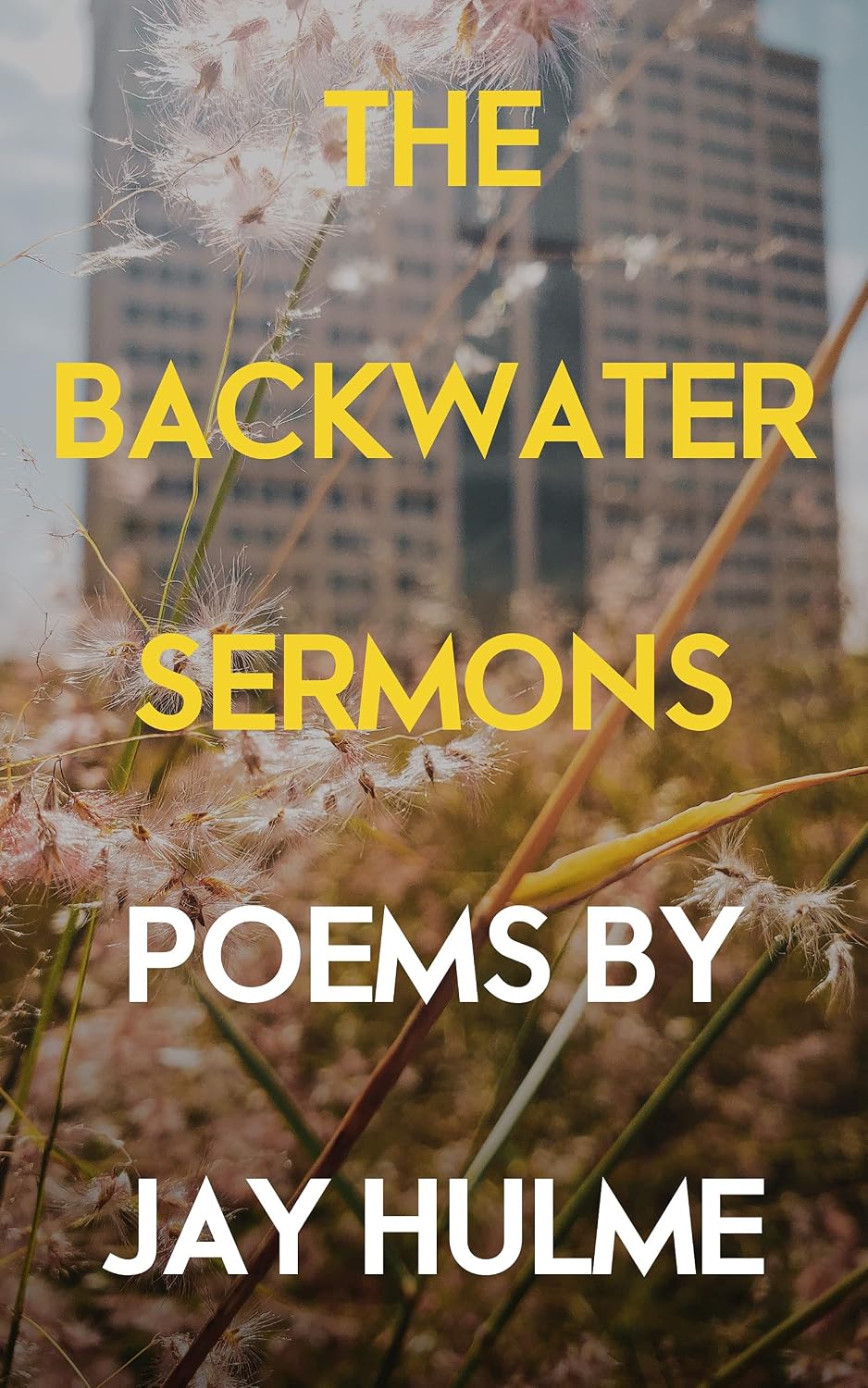
The Backwater Sermons
Jay Hulme
Canterbury Press Norwich, 2021, 96 pages
$16.99
Reviewed by Allison Quinlan
My interest in religion (specifically Christianity) and queerness tends to rest in the intersection of harm done to the community by the Church, and how (or should) the breach be repaired. Between you and me, I generally dislike the works that shuffle aside the harm by including a rainbow on the home page and slapping “affirming” on their website, simply because I rarely see actions of support and help following the front-facing symbolism. Of course, having pride flags and affirming language is a good thing; I don’t mean to critique that, I just want more than the minimum. With that in mind, I was fascinated to encounter Hulme’s collection, in no small part because it leaned more on the celebratory side of belief, and was written by a trans author.
I first spotted Hulme’s work on an Instagram reel (scrolling, rather than working!) during Pride month in the UK. The poem, titled “Jesus at the Gay Bar,” painted a picture of Jesus on the dance floor, happily in the midst of all the other queers, spinning and affirming through the space: “my beautiful child / there is nothing in this heart of yours / that ever needs to be healed.” (88). Hm, instant interest from a former baptist here. I searched up the author, the book, the cost, and added it to my wishlist. Since reading, I’ve found that the collection continues its affirmation of LGBTQ+ identities while clearly grappling behind the scenes with the dominant narratives from religious institutions about the community. In “Atheist out of Necessity,” Hulme writes, “Brother, you are not alone in this; / the church has an empire of / wrongs weaved into its being / and sometimes there is no going back.” (32). It’s true, sometimes there is no going back. The collection makes space for those who need to block out the Church, as much as it does for those who want to embrace it.
The entire work isn’t centered on queerness (arguably, as authorial identity is often inseparable from our works) and touches on themes of community during the pandemic and Hulme’s dive into belief. However, towards the latter half of the book, readers find more explicitly queer poetry, notably “This Body” (a litany of ‘this body is’ where a queer body is known and declared as: creation, holy, enduring, worship . . .) and “Martyrdom”—which is one short line: “Being Queer shouldn’t get us killed / but” followed by an empty poem, spaces where words should be, bracketed by punctuation, yet silent (56). Another poem, “Queer is a Calling,” is a lovely short piece noting the Church wants us to be ashamed of ourselves as queer beings, and so asks god then, why they made us—and answers the question, explaining, “We were called to / complete your creation” (89).
The collection ends with “Beatitudes for a Queerer Church.” I won’t reproduce the entire poem here, but I almost wish I could. As a queer person with a religious background, Hulme’s “Beatitudes” are one of the most impactful poems in the collection for me. I’ll keep it to my two favorite lines:
“Blessed are the queers; / who love creation enough to live the truth of it, / despite a world that tells them they cannot. / And blessed are those / who believe themselves unworthy of blessing; / what inconceivable wonders you hold” (90).
Blessed are the queers. We hold inconceivable wonders.
I appreciated the acknowledgments throughout that even if we as queer people fold religious beliefs into ourselves, we should still grapple with the institution itself—be that in deconstructing through pointing out the structures that reinforce power imbalance and hate, or through reclaiming and correcting religious texts and practices—we still have work to do, and work to demand the Church does. Overall, I found I enjoyed the collection more than I thought I would, as I was quite ready to come in hot with critiques.
Allison Quinlan is a researcher and PhD candidate, as well as a support provider for survivors of abuse. She is definitely not a baptist, but was raised in the Bible Belt, so, hey, what can ya do? Religious language has such a poetic draw (to her), especially when paired with queerness.
"Empowerment comes from ideas."
― Charlene Carruthers
"Your silence will not protect you."
— Tourmaline
"Gender is the poetry each of us makes out of the language we are taught."
— Leila Raven