






Sinister Wisdom Newsletter
Login (ONLY for SW staff)


Review of DEAD BOYS IN SPACE by Sara Youngblood Gregory
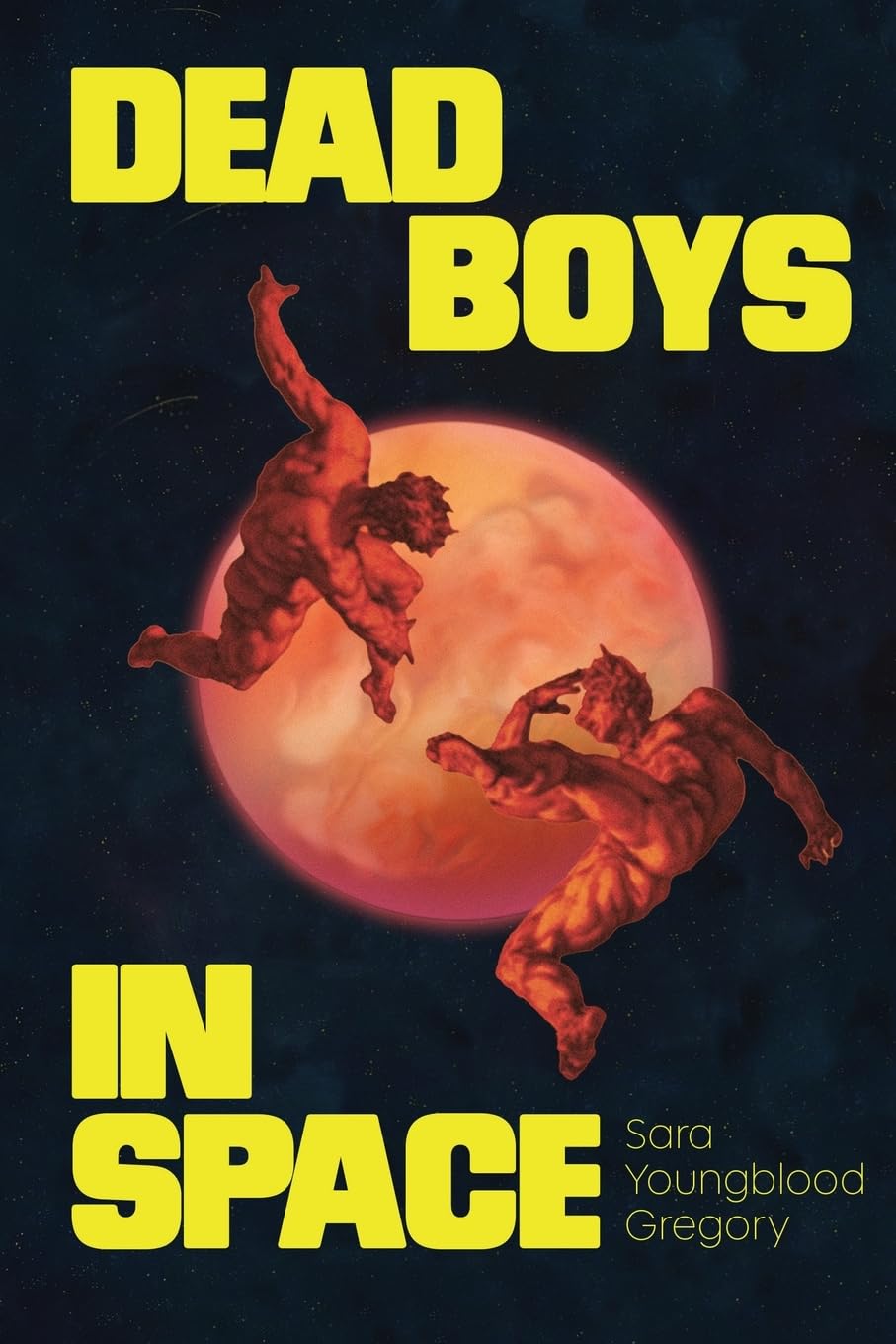
DEAD BOYS IN SPACE
Sara Youngblood Gregory
YesYes Books, 2026, 102 pages
$22.00
Reviewed by Marisa Lin
Sara Youngblood Gregory’s debut full-length poetry collection, DEAD BOYS IN SPACE, is an imaginative fusion of lyricism, experimental forms, and speculative fiction that explores otherness, grief, illness, and queer resistance in American history. In this collection, Youngblood Gregory, award-winning lesbian journalist and editor of Sinister Wisdom’s forthcoming issue Butch-Femme Renaissance, demonstrates a remarkable ability to join poetic depth with incisive social critique in this brilliantly crafted collection.
Mourning their brother and generations of queer elders while navigating their own queer identity, relationships, and parental ruptures, the central speaker of the collection falls upon supposition to fill the gaps of what they lost and perhaps can never be known. The collection itself begins with the speaker envisioning their brother, whom they have never met, “going to clubs / on the moon. . . where Friday nights are / for diamonds / instead of air” (11). So begins the collection’s metamorphosis of queer grief and its political origins, which Youngblood Gregory traces to the U.S. government’s historical response to the AIDS epidemic that significantly impacted gay communities.
DEAD BOYS IN SPACE enters into the aftermath of this devastation and offers a nuanced critique of the political dynamics of this era. By intersecting the hostility of this era with the country’s efforts in the Cold War space race, Youngblood Gregory’s collection illuminates the ways American imperialism and anti-queer politics are enmeshed together through ideologies of control and expansionism while offering a testament to the enduring ability of queer lives to resist, mourn, conspire, and ultimately find home in the most inhospitable of places.
As all grief does, this book begins with absence: of the speaker’s unnamed, gay brother, of the generations of queer elders decimated by the AIDS epidemic. As the speaker comes to terms with the “paper trail of old men that should be here but aren’t” (21), another ghost arises: the secondary, haunting sorrow of not truly knowing what—or whom—one lost. The speaker, in one poem, laments, “My mother won’t tell me if heatstroke killed my brother or the sweating gorgeous twinks who looked but never found” (18), and in another, “my god I miss the elders I have never known” (50). It is the silence around these lives—the kind that attempts to erase them from cultural and familial memory—that propels this collection to do the opposite. In “Eulogy,” brief, fragmented lines evoke pebbles of memories one might fish up from the past, in which the speaker asserts of their brother:
there may be
a world
in which
your name
is never
again
spoken
but that
is not
this world (22).
With this refusal, the speaker thrusts themselves into the unknown—which through the collection turns from an unsettling void to one of generative possibility and transformation. Similar to how the speaker in “BLOODSHIFT”—an intensely bold, orgasmic poem that explodes open the book’s second section—declares, “WHAT IT IS TO BE HUMAN CHANGES / UNDER WATER” (35), this collection manages to turn the speaker’s “precious / sinking / grief” (23) into something that—to draw from the book’s final poem—the wind truly does catch.
To arrive there, Youngblood Gregory plays with elements of speculative fiction. She uses these elements not simply as a means to probe the unknowable, but to reveal the truth of the present and cast it open to change. While speculation originates from the imagination, this collection demonstrates its power to reveal reality. In “If you ask me why I read science fiction,” Youngblood Gregory writes, “The answer is that there is no such thing as fiction / there are just worlds / as bad as this one” (75). So when “One Million Dead Men: An Empirical Investigation Into New Sodom,” the intriguing, central poem in the collection, details a professor giving a controversial lecture on a government conspiracy to kidnap the gay male population and resettle them on the moon, the effect is a startling illustration of how gay communities served as collateral in the clash of social, economic, and political forces in America.
But beyond issuing clarity, Youngblood Gregory’s speculation wedges alive a gap for new modes/registers/dreams of resistance. For instance, to transform illness “into a weapon”—a response that Youngblood Gregory credits via Amy Berkowitz to the Socialist Patients’ Collective, a German activist group that identified capitalism as “the root of all illness” (41). Indeed, the voices and memory of ill and queer elders—such as Mark Lowe Fisher, Duane Kearns Puryear, and David Wojnarowicz—echo throughout these pages, which seem to weave together an ancestral chorus of resisters who used their illness to disrupt oppressive power structures and make room for the possibility of other worlds.
Following this tradition, the men in “One Million Dead Men: An Empirical Investigation Into New Sodom”—ill, exiled, and resettled from Earth manage to elude their assigned fate to “fuck themselves to death” (57), or at least the official documentation of it. The subversion of their exile into disappearance from the gaze of formal power structures provides a freedom more expansive—for who could surveil the universe?—than anyone could have imagined. But this possibility was imagined, and that is perhaps the heart of DEAD BOYS IN SPACE: queer resistance as carving hidden paths to liberation.
The book’s series of GRID poems is a striking example of this. The acronym GRID, which stands for “Gay-related Immune Deficiency Syndrome,” the former name of AIDS that dangerously conflated gay communities as sources of disease, offers an unexpected poetic form in the shape of a grid. These grids evoke confinement and taxonomic-like arrangements, with each box containing fragments of conversation, lists, and references. Here is the second poem of the series.
The content and shape of these grid poems reflect the sense of dismemberment—of self, communities, relationships—that queer people must often contend with, as well as hypervisibility and scrutiny that we are often subject to. But as generations of queer elders have long done, this collection takes these fragments and makes them fly. The collection’s concluding poems, “Though they thought we were caged, we were actually sewing” (82) and “O and the wind truly does catch,” (85) makes one see these GRID poems differently: not as cages, but as quilts—specifically the AIDS quilt, an immense, weighty memorial (it is estimated to weigh around 54 tons) to lives lost to the illness. Despite its pieces being the size of a “standard grave,” Youngblood Gregory writes that the quilt itself is not a “funeral shroud” but rather is something more buoyant, a messenger that lifts off and takes with it “the weight of all those lives” (83), its launch into the atmosphere signaling both a farewell and the start of some great journey.
In this way, Youngblood Gregory’s poems climb and eventually soar, from documenting the intimacies and griefs of queer life to finding new visions of miraculous, ancestral unknowns on the moon. DEAD BOYS IN SPACE is perhaps a reminder to welcome the gaps and enter them, and find that what most terrifies us can also be the very thing that will free us.
Marisa Lin is a writer and daughter of immigrants. Their work is published in Poetry South, Porter House Review, Cimarron Review, and the Academy of American Poets’ Poem-A-Day series. DREAM ELEVATOR, their debut chapbook, was published by Kernpunkt Press (2024).
"Empowerment comes from ideas."
― Charlene Carruthers
"Your silence will not protect you."
— Tourmaline
"Gender is the poetry each of us makes out of the language we are taught."
— Leila Raven