






Sinister Wisdom Newsletter
Login (ONLY for SW staff)


Review of Crying in LA: Sapphic Longing in Tongues and Tears by Jasmin Benward
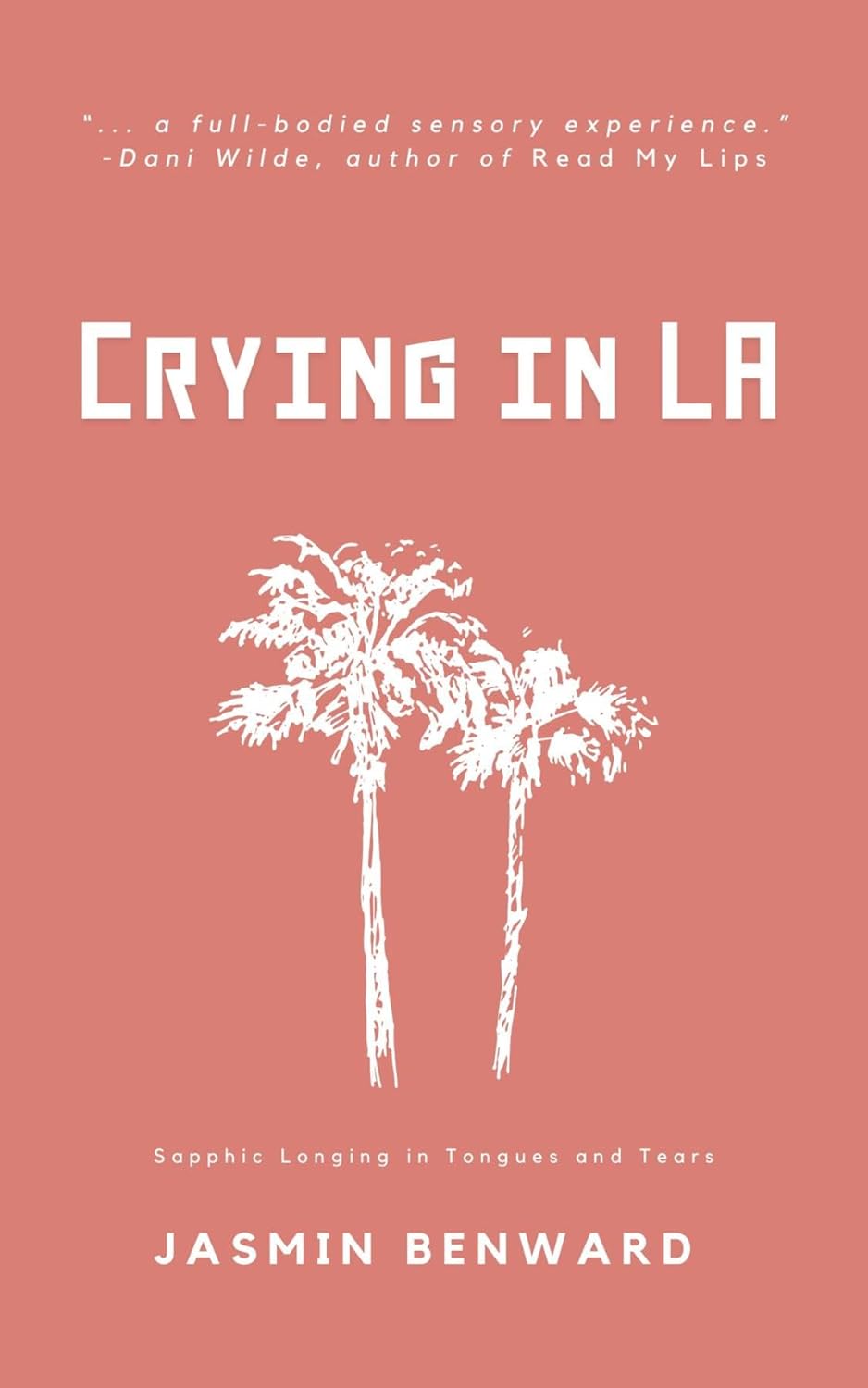
Crying in LA: Sapphic Longing in Tongues and Tears
Jasmin Benward
Tehom Center Publishing, 2025, 158 pages
$23.05
Reviewed by Nino Arobelidze
Jasmin Benward’s Crying in LA: Sapphic Longing in Tongues and Tears refuses to separate desire from dignity. Structured through an emotional forecast of “Sunny Skies,” “Partly Cloudy,” “Chance of Rain,” and “Showers,” the collection traces the intimate weather of longing with intention. Early poems dwell in flirtation and sensory closeness, while later pieces move toward rupture, grief, and a hard-won clarity shaped by loss. The sequencing feels deliberate. The poems read less like a loose gathering and more like a carefully arranged album, complete with refrains, tonal shifts, and thematic reprises.
The voice is direct, musical, and scene-driven. Early poems linger in everyday tenderness, where coffee, food, sound, clothing, and shared ritual become portals into intimacy. “Over Coffee” and “Come Close” situate affection within cultural specificity and shared presence. Affection unfolds through repetition and shared ritual, allowing intimacy to take shape through presence rather than declaration, as in the line “When you come close / You feel like a Sunday” (19). Elsewhere, Benward’s lines move with the confidence of spoken word while retaining visual texture and lyric punch. The result is work that feels both conversational and immersive.
Intimacy is positioned as something sacred rather than performed for an external gaze. The erotic poems move with unapologetic agency, framing desire not as spectacle or confession but as connection and choice. In poems such as “Sex Magic” and “Sub,” desire is rendered as lived, embodied experience rather than abstraction, where sexuality becomes a site of imagination and devotion, as in the line “I hear the grind of your chains drip from your body” (60). Intimacy remains deliberate and embodied, grounded in the speaker’s control of voice and perspective.
Throughout the collection, desire is situated within explicitly Black cultural and political realities. Poems such as “Passport” and “Selfish Black Futurism” expand the scope of longing beyond romance. The speaker names censorship, land, diaspora, disability, autonomy, and surveillance as lived contexts that have shaped her sense of intimacy and visibility. These forces appear not as distant ideas, but as conditions the speaker moves through. Yet love is never abstract. It unfolds inside systems that shape who is seen, protected, or erased. “In this world I am chosen / Other people’s opinions don’t exist” (107). By anchoring intimacy within these realities, the collection insists on specificity over universality.
As the emotional arc shifts into “Chance of Rain” and “Showers,” the poems turn toward heartbreak and self-interrogation. Modern forms of absence appear through social media monitoring, quiet surveillance, and the contradictions of no contact, where the speaker watches, checks, and registers presence without response. As “Banned” captures, “I know I occupy stolen lands / why don’t you? / I’m governed by sacred law / I have a voice, and / I have choices” (149). Benward renders longing through these small, contemporary rituals of looking and waiting.
By the time the collection arrives at the title poem, the focus broadens to vocation and inevitability. The speaker affirms her identity as storyteller, musician, and witness, declaring, “I praise the moment that / Happy tears, are / What have me crying in LA” (p. 156). Longing has not defeated her. It has shaped her language. In Crying in LA, tears are not only about heartbreak; they register ambition, authorship, and the persistent belief that one’s voice is meant to take up space.
Crying in LA offers a portrait of Black sapphic longing that is sensual, funny, political, wounded, and luminous. It honors pleasure without trivializing it and documents heartbreak without romanticizing it. Benward’s collection reminds readers that to desire deeply is also to risk deeply, and that telling the truth about that risk is its own form of power.
Nino Arobelidze is a writer, vocalist, producer, and mixer working across music, film, and narrative forms. Her work explores longing, identity, and emotional architecture through sound and language. She creates under the moniker Girl Named Nino.
"Empowerment comes from ideas."
― Charlene Carruthers
"Your silence will not protect you."
— Tourmaline
"Gender is the poetry each of us makes out of the language we are taught."
— Leila Raven