






Sinister Wisdom Newsletter
Login (ONLY for SW staff)


Review of Midsummer Count: New and Selected Poems by Robin Becker
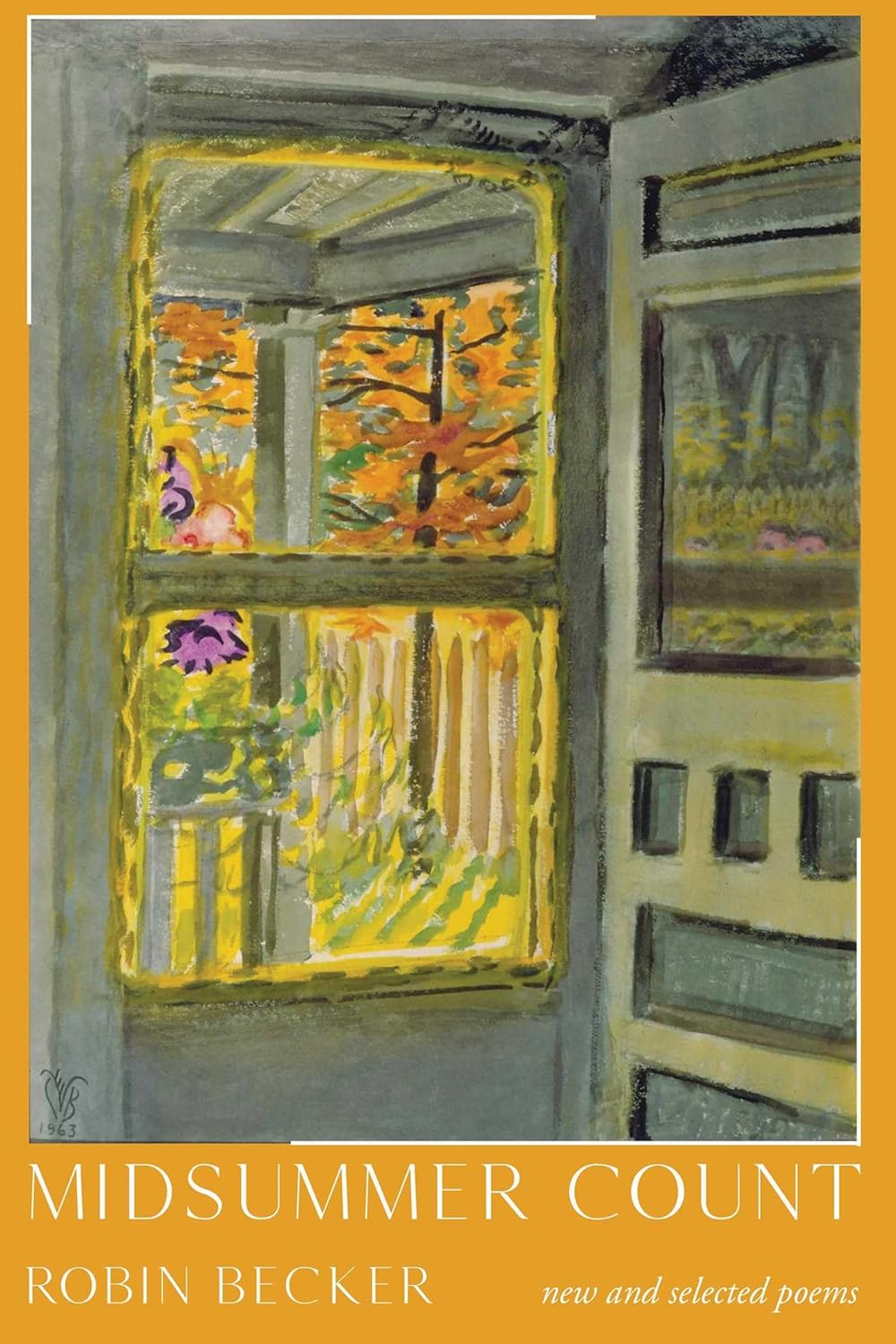
Midsummer Count: New and Selected Poems
Robin Becker
University of New Mexico Press, 2026, 162 pages
$21.95
Reviewed by Ellen Miller-Mack
It’s April 17, 1977. The feminist poetry press Alice James Books is four years old. In the previous year, Robin Becker’s first collection of poems was published alongside Helena Minton and Marilyn Zuckerman in Personal Effects. All three come to the University of Massachusetts at Amherst for a reading; they were invited by Spectrum, the campus literary journal. As I listen to Robin read “A Woman Leaving a Woman” I feel my young life change indelibly.
Poetry changes us. It’s been altering internal landscapes of humankind with powerful revelations for thousands of years. Lyric narrative poems illuminate paths forward through a broad range of feelings. Becker’s Midsummer Count: New and Selected Poems, traverses fifty years of feminist observation, depth, humor, and a very particular bold voice. As an out lesbian since the 1970s, she has inspired generations of queer women with her exploration of relationships that are unique to us, as well as Jewish identity. Becker’s work also has a universal quality, with themes ranging from family dynamics to loss.
In Don’t Read Poetry: A Book About How to Read Poems, Stephanie Burt writes, “Lyric poems show you yourself and somebody else; they show you what you have in common, not with everybody, but with somebody else, which means they can be mirrors and also windows.” With this quote in mind, I sit with all of Becker’s books stacked in front of me, breathing them in. Becker’s poems are both mirrors and windows. There is a translucency and clarity to her work. Her poems can take you by surprise as they skillfully guide you towards a moment that leaps into your own inner life. There’s a wide range of subjects in this expansive collection: well-crafted poetic responses to shifts in the poet’s internal landscape through connections with memory, people, and animals in her life. Sometimes a sketch. Sometimes a painting. Sometimes unexpected. Becker’s poems move with a smooth glide. It can feel somewhat restrained, with perspective from a slight distance, void of palpable vulnerability like other poets. Perhaps it’s a result of her awareness of the cultural significance of her work.
I like to imagine Robin Becker working a poem like a chunk of clay. The clay is the idea, and the lines are the myriad shapes she makes with it. She consistently demonstrates intellectual prowess as well as playfulness with language. She can pluck an idea from thin air, and put it to work. When she juxtaposes ideas or feelings, she provides tension, friction and a bit of distance. The poem “Semblance” begins, “The dog I love is turning into my father” and though some may experience this line with a wave of affection for both, that is not where the poem goes. It is explicitly about her old dog’s behavior—he can’t help it, he’s gotten a bit ornery—and implicitly about her father who “never had much use for my conversation // and showed his teeth when I / displeased him / collared as he was / and made to heel by his betters” revealing trauma endured by both her rescue dog and her father. The poem is written in tercets with run-on sentences and no punctuation, and I can’t think of another Becker poem utilizing this form. As is typical of her poems, there is no neat resolution, and the ending is startling.
There are new poems in Midsummer Count, followed by a journey through Becker’s distinguished career, with poems from all eight of Becker’s collections. Among the new poems, “You Have to Stay Ahead” is about pain with an expertly sustained train metaphor. Here are the first eight lines:
of the pain, she said, it’s a high speed
train gaining momentum,
headed for the town with your name.
You have to stay calm, seated, sedated
as the locomotive nears, curves
into view, freighted with your fears
of complication, infection,
pain’s hue and viscosity.
“The Walking Cure” contains various numbers documenting time, distance, and other measures, as if they could somehow contain the grief of losing a sister.
On June 24, 1986, she walked twenty-three
and-a-half miles, noting, “Hot. 97 degrees.”
On July 5, twenty miles in the rain.
In “Rescue Parable” we witness a rescue dog who “digs with his forepaws a grave, // and with his nose, dutiful as one enslaved, / covers with dirt the coming poverty.” Becker writes frequently about dogs and other animals. The subject in this poem is deep, persistent trauma and how nearly impossible it is to overcome: a wrenching situation for all of us mammals.
“Raccoon” presents the creature who is “Comedian of the hard frost, / deft champion of screw-on tops” now dead in the middle of the road and somehow lovingly paired with her zayde, her grandpa. Becker makes these kinds of connections work.
In “The Fix” she explores her friend Harvey’s approach to repair, creatively using whatever materials and tools we have in the moment, with a splash of magical thinking:
Harvey says it will hold for now meaning the gasket
he’s rigged to stop the leak in the water tank
And here, exquisite tenderness, in the love poem “The Subject of our Lives.” It ends with:
. . . Trust me, you say, and I am struck by the force
of your voice, the imperative form of any verb spoken in bed. Come home.
No, stay where you are. Longing will serve us while snow thickens
the sidewalks, delays the subways, tightens every street in town.
Becker’s playful side appears from time to time. In “UPS,” one of the new poems, she fantasizes about a “short marriage,” because for her, it’s too late for a long one:
UPS driver in brown shorts
with a pencil parked behind her ear.
I know she likes me by the way
she takes a granola bar from my hand,
shouting “hey, thanks”, as she runs
to the brown box of her truck.
I think she’d like to have coffee, talk
about her childhood, her favorite books
and movies, her vacation in P-town.
“Men as Friends” with an amusing first line, “I have a few which is news to me,” concludes with a gift from James the retired Marine who leaves two rainbow trout in her refrigerator, a nod to Elizabeth Bishop’s “The Fish.”
Robin Becker has been serving poetry superbly for decades. Becker’s poems are carefully constructed with inner logic, but they are not cold. As through an open window, her figurative language continues to invite us in. She illuminates the small truths of our lives with clarity. For those who identify as feminist, lesbian, or Jew, Becker’s poetry is both validation and celebration.
Ellen Miller-Mack is a nurse practitioner (retired/rewired) with an MFA in Poetry from Drew University. Her first book, When I Was a Grateful Mammal, won the 2025 Sappho’s Prize in Poetry from Headmistress Press. Her book reviews have appeared in Rattle, Valparaiso, Bookslut, The Rumpus, The Poetry Café, and Poetry Foundation. Ellen co-wrote The Real Cost of Prisons Comix (PM Press). She is the host of Poet Talk, a live radio program on WMUA. It is also on Spotify and Apple Podcasts.
"Empowerment comes from ideas."
― Charlene Carruthers
"Your silence will not protect you."
— Tourmaline
"Gender is the poetry each of us makes out of the language we are taught."
— Leila Raven