






Sinister Wisdom Newsletter
Login (ONLY for SW staff)


Review of Hauntings by Vernon Lee, in conversation with Gretchen Felker-Martin and Kayla Kumari Upadhyaya
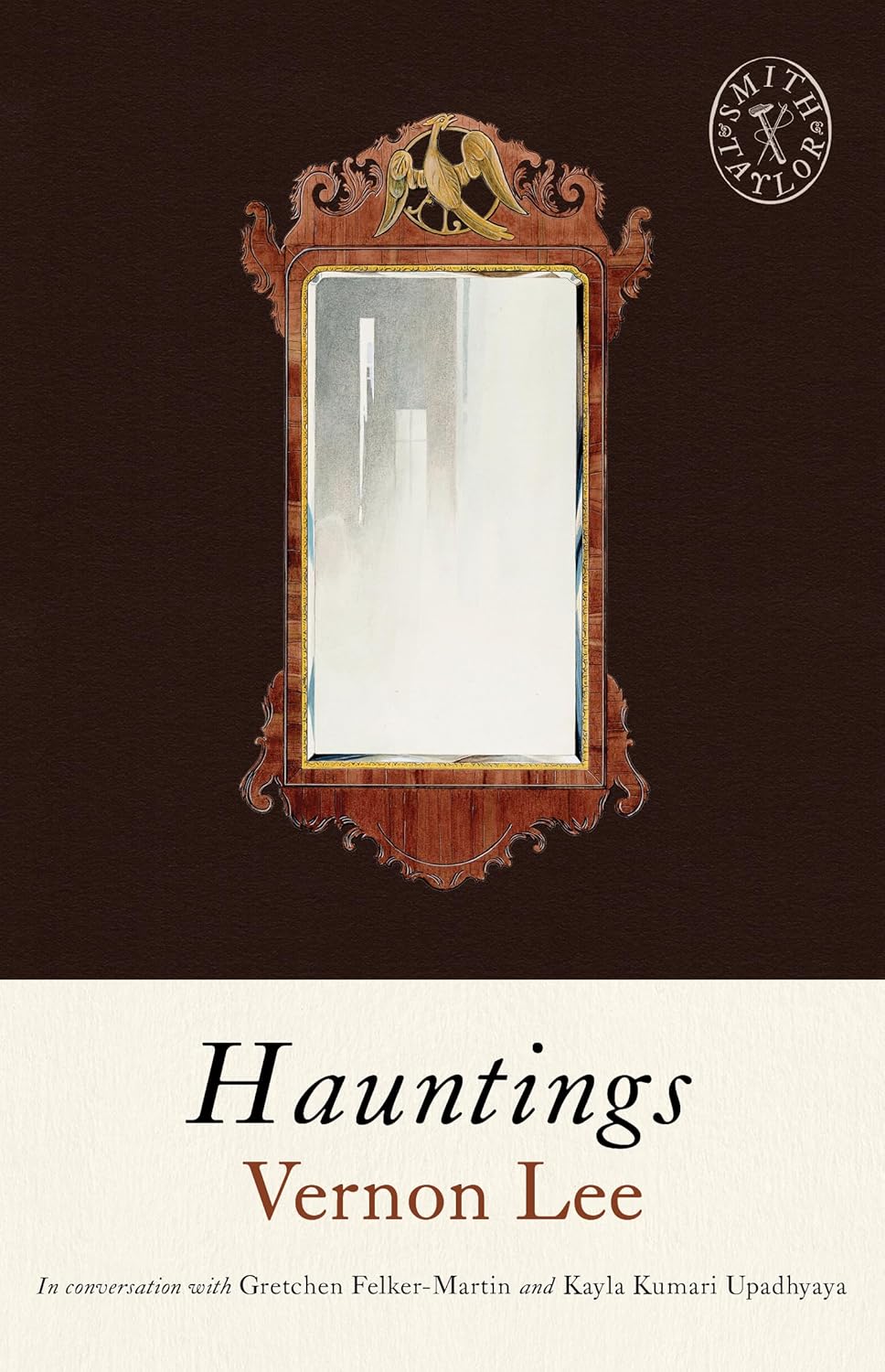
Hauntings
Vernon Lee, in conversation with Gretchen Felker-Martin and Kayla Kumari Upadhyaya
Smith & Taylor Classics, 2025, 198 pages
$17.95
Reviewed by Rivaa Ubrani
Vernon Lee’s Hauntings is a lusciously gothic quintet of stories whose intricate Italian settings echo with the ghosts and goddesses of half-remembered girls and women. Writing behind the pseudonym “Vernon Lee,” Violet Paget was one of the forerunners of supernatural fiction whose various stories were serialized in British literary journals during the late 1800s.
Despite writing amidst the general late Victorian craze for ghost stories, Lee distinguished her tales with their embodied settings, at once intimate and alienating to readers. Drawing from her own rich history of travelling, Lee’s nomadic characters radiate an “in-betweenness”; they neither fit into Lee’s Italy as locals nor into Lee’s world as persons, tending as they do to flicker between the real and the spectral realms of being.
Lee’s tales, with their ambiguous endings and psychological half-thrills, are in a sense deeply queer stories. Lee herself was both a staunch feminist and a pacifist who used her pseudonym proudly in both her private and public life and was known to dress in “mannish” attire. This, coupled with her refusal to abide by the heteronormative marital norms of the late Victorian period and her intense friendships with women, has led critics to read Lee as a queer woman.
Though confirming such a claim is elusive and perhaps historically invasive, lesbian experiences nevertheless color the pages of Hauntings. Morally gray women and feminine men take the starring role in all Lee’s stories, blurring the lines between guardian angels and succubi. They play witches, murderesses, and phantasmic Italian noblewomen who both bless and curse the tales’ protagonists with equal vigor.
What truly haunts Lee’s characters, though, is the power of art. Whether in sculpture, as song, or as a carefully-crafted portrait, the artistic looms over Lee’s Hauntings as a wraith-like presence—an unattainable ideal at once hankered-for and horrifying. Her collection thus operates in line with one of poet Rainer Maria Rilke’s most notable quotes: “For beauty is nothing / but the beginning of terror, which we can still barely endure, / and while we stand in wonder it coolly disdains / to destroy us” (“The First Elegy”).
The most moving of Lee’s tales is her opening story, “Amor Dure.” A short story conveyed in epistles that frames the slow coming-of-age of a sea witch from an uncannily detached perspective, this tale combines mythic tropes and Mediterranean imagery to bolster the emotional impact of its slowly unravelling yarn. Cursed to bring every soul she encounters to romantic ruin, this sea witch inverts the norms of the seaside Italian coast she washes onto, effectively annihilating them with her beauty.
I invite everyone to be annihilated by this and the rest of Lee’s uncannily gorgeous meditations on the artistic process as soon as you can.
Rivaa Ubrani (she/her) is an Indian poet, editor, and aspiring children’s book author, based in London, where she is pursuing an MA in Shakespeare Studies and interning at Sinister Wisdom. Her work often traces the intersections of mental illness, myth, and the hyperreal.
"Empowerment comes from ideas."
― Charlene Carruthers
"Your silence will not protect you."
— Tourmaline
"Gender is the poetry each of us makes out of the language we are taught."
— Leila Raven