






Sinister Wisdom Newsletter
Login (ONLY for SW staff)


Dyke Bar* History: 1920s-1930s #2 Le Monocle, Paris, 1932
Dyke Bar* History: Le Monocle, Paris, 1932
Jack Jen Gieseking with Michaela Hayes, Mel Whitesell, Paige LeMay, Syd Guntharp, and Sarah Parsons
To complement the launch of the Our Dyke Histories podcast, hosted by Jack Gieseking and co-produced in collaboration with Sinister Wisdom, we’re sharing a reading guide for the decades. For the first season, Our Dyke Histories is spotlighting dyke bars*: lesbian bars, queer parties, and trans hangouts; the structures that made them necessary, the lives they made possible, and the worlds we built from them.
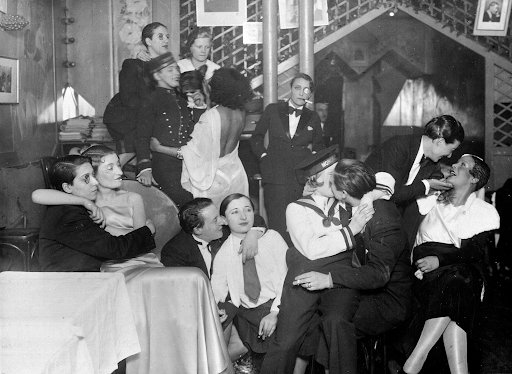
Georges Brassaï’s 1932 photographs of Parisian lesbian club Le Monocle are some of the most enduring images of early 20th century queer nightlife. The monocle itself—worn by masculine women in Paris and in normative-bending circles across Europe—is a specific queer visual code, a marker of gender presentation and affiliation. In other words, the monocle is the early 20th-century Parisian equivalent of the 2000s' carabiner.
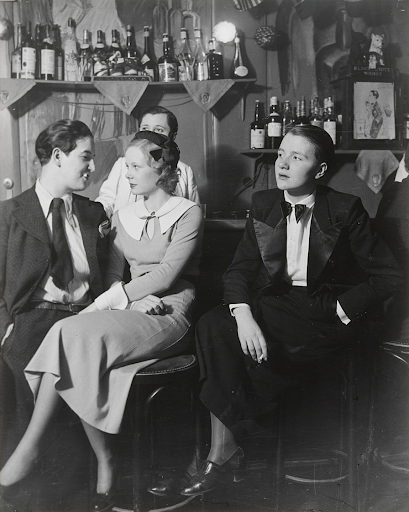
The images offer a dense visual archive: Lulu de Montparnasse, the club’s owner, in tailored menswear; patrons whose postures and gazes index intimacy, ease, and self-fashioned gender; the juxtaposition of elegance and risk that characterized interwar lesbian nightlife. The most reproduced image depicts the butch athlete Violette Morris and her partner.
Morris’s life, both extraordinary and troubling: she was an Olympic-level athlete with over 50(!) medals, gender nonconformist who had a double mastectomy because she said it was thus easier to drive her racecar, and, tragically and violently, a collaborator with the Nazi regime. Morris’ life speaks to the complexity of queer history, and how we complicate and must confront the fascism of today.
Viewing the Le Monocle photographs nearly a century after they were taken, we’re struck by the similarities between patrons of Le Monocle and modern dykes. Many of us still dress to the nines to stare pensively into the distance. These photographs resonate not because they romanticize the past, but because they show a lesbian place that is recognizable: a room where dykes and trans people gather to see and be seen, to craft gendered and erotic worlds with one another.
Notably, Le Monocle lasted on for decades, a rare accomplishment for a lesbian bar. It was also a hub for sex workers and a place where working-class dykes gathered.
Paris rang all strata to its urban enclaves, like a clear bell of where to find home. Paris was brimming with wealthy lesbianism the likes of Natalie Barney’s salons, Gertrude Stein and Alice B. Toklas’ walkabouts and rideabouts, and many other many dykes. If you want to dive deeper into the historical muff of a century of lesbian Paris, we heartily recommend Tamara Chaplin’s thick and detailed Paris Becoming Lesbian: A Queer History of Modern France. And if you just want to know about the wealthy, or you too are obsessed with the birth of modernism, Diana Souhami’s No Modernism Without Lesbians is the perfect beach read.
- The LezQueer World before Bars: 1920s-1930s with Lillian Faderman & Cookie Woolner (Part 1)
- When Paris and Berlin Were Dyke Bars* of the 1920s-1930s with Lillian Faderman & Cookie Woolner (Part 2)
- Tea, Anarchy, and the First Dyke Bar: Eve’s Hangout 1925 with Jonathan Ned Katz (Part 1 of 2 with Katz)
- Books, Bulldaggers, and the Birth of Lesbian Research with Jonathan Ned Katz & Julie Enszer (Part 2 of 2 with Katz)
Read the rest of the series:
Dyke Bar* History: 1920s-1930s Reading Guide
A reading guide for the decades.
by Jack Gieseking & the Our Dyke Histories podcast team
Eve’s Hangout, Greenwich Village, 1926
Le Monocle, Paris, 1932
Harlem Rent Parties of the 1920s and 1930s
"Empowerment comes from ideas."
― Charlene Carruthers
"Your silence will not protect you."
— Tourmaline
"Gender is the poetry each of us makes out of the language we are taught."
— Leila Raven
Add new comment