





Sinister Wisdom Newsletter
Login (ONLY for SW staff)


Review of Mega Milk: Essays on Family, Fluidity, Whiteness, and Cows by Megan Milks
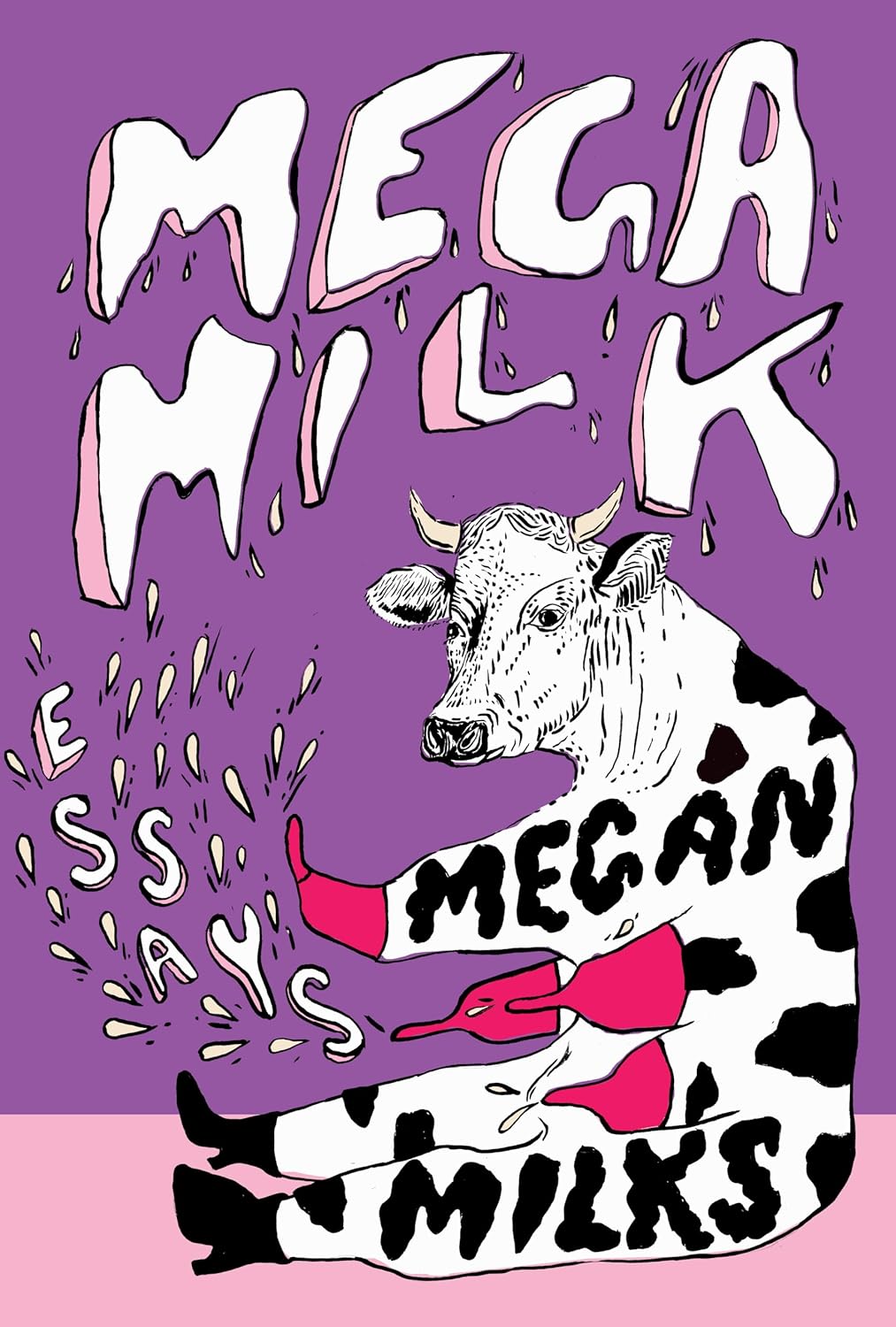
Mega Milk: Essays on Family, Fluidity, Whiteness, and Cows
Megan Milks
Feminist Press, 2026, 336 pages
$17.95
Reviewed by [sarah] Cavar
Milk: It’s everywhere, in everything (12). So says Megan Milks in Mega Milk, a wide-ranging reflection on race, gender, size, species, and milk, a secretion that looms large in the U.S. corporate-cultural zeitgeist. Milk has undergone something of a transition in the decades since Milks’s childhood, shifting shape from a hallmark of the healthy, all-American, and notably white diet, into something of a commercial downward spiral, blame for which has been attributed to anything from Gen Z, to veganism, to allergies. With this fluidity in mind, Milks is invested in the “trans potentiality of milk” (28), the capacity of the fluid to shift shape and meaning not only in rhetoric, but in the bodyminds of those who produce, exchange, and consume it.
In approaching milk’s trans potentiality, Milks begins with what might be understood as the cis potential of milk, detailing the lives of cows subjected to abusive breeding and milking regimes, either as incubators or as inseminators. For Milks, the lived experience of cows is entangled both with life-giving (sustenance for their late cat, Claude) and life-taking (the premature killing of those cows that have outlived their “production value” [86] as well as the suffering of migrant workers, including children, forced to work on these farms). Likewise, they acknowledge that, as a formula-fed baby, cows have been something of a “foster mother” (132) to them—coming into uncomfortable proximity with the racialized and classed position of prior centuries’ wet nurses.
The trans potentiality of milk also emerges in its crossings from word, to name, to material necessity. “Milk,” as a word, summons “cow,” a term appended to fat, feminized people, Milks’s child-self included. Milk, and its absence, becomes symbolic of Milks’s disordered eating. Additionally, the material attachment of milk to the breast—and, by extension, to femininity, motherhood, and the concept of femaleness itself—is rich territory for trans exploration: in “The Letdown: Lactation Suite,” Milks historicizes their relationship to a body coercively assigned female at birth; the complexities of binding, intimacy, and self-knowledge; and to the expectations and demands placed upon nursing parents.
Much like the contradictory expectations placed upon trans people—both to transition “fully” for legitimacy’s sake, and not to transition at all—nursing parents (understood as “mothers”) face dual pressure to embrace the “naturalness” of the breast and to embrace the science of formula so as to preserve their looks and properly nourish their children. This places people of marginalized genders, whether nursing or not, into what Milks correctly puns a “double-bind”: there is no way to fully satisfy a cisheteropatriarchal system in its insatiable hunger for subjugation across species, gender, and positionality.
Race, too, is implicated in the commercial and symbolic impacts of milk, particularly for the U.S. In the essay “MAGA Milk,” Milks quotes a speech by then-Secretary of Commerce Herbert Hoover in 1923: “Upon this industry, more than any other of the food industries, depends not alone the problem of public health, but there depend upon it the very growth and virility of the white race” (172). Indeed, the racialization of milk—not to mention its embeddedness in systems of white, christian supremacy—extend further back than U.S. empire: in Medieval and Renaissance Europe, breastmilk was understood as excess menstrual blood, saved and transmuted in order to feed newborn babies. “Bad milk,” including milk contaminated by unsanitary dairy practices, was an affront not only to a baby’s health but to its selfhood, a kind of ontological contamination informed by racist, classist ideologies. Later, after a cultural flip spurred on by the American eugenics movement, healthy, “pure” milk became a hallmark of the fit family—once again, milk consumption (albeit of a different kind) was a prerequisite for purity, goodness, and normality.
It is no surprise, then, that Milks’s best moments in this collection are moments of profound impurity—moments where their thoughts cross from human to nonhuman, diluting the myths of fitness and purity the image of milk now offers. Milks, in escaping themself, escapes the inevitable inadequacies of anthropocentric interpretation when attempting to approach nonhuman ways of knowing. In the startling essay “Milking the Bull,” Milks decides to inseminate themself with the sperm of a bull, and in so doing, internalizes and ultimately reproduces his story in a queer, literary (re)birth. The latter pages of the essay are devoted not to Milks’s experiences, but the bull’s, and the reader follows the narrative to his life’s inevitable end. This essay—perhaps the most uncomfortable in the entire collection—is a highlight, both for its taboo subject matter and for the empathy and intentionality of its portrayal. In this moment, more than any other, Milks sits in the crevice between their body and another’s, and asks what it means to cross that boundary, to trans it, together.
As a constellation of essays on milk’s many meanings and potentialities, Mega Milk is deeply, powerfully uncomfortable. At times, I felt impatient with the text, eager to move from moments of observation and reflection to critical analysis, particularly regarding the nonhuman animals on whose bodily fluids the book relies. Particularly in moments where milk is present but its nonhuman producers, notably, are absent (such as in “Tres Leches”), it feels as though cows are a specter haunting a story that tries to be about something else—about gender, about economics, about family, about identity. While touching on the ethical and environmental urgency of critique, Mega Milk is persistently reflective in a way I did not expect, and struggle to collect my feelings about.
At the same time, Milks anticipates my critique, meets it before it escapes my mouth, or my hands, onto the page. “No, it’s personal essays,” they explain to a Hindu physical therapist, who asks if the collection is “making a case against dairy” (265). In a roundabout way, Milks has, throughout the course of the text, called out some of my own bona fides: whiteness and rurality of upbringing, transness and chosen distance from the “femaleness” yoked to us from birth, experiences of restrictive, disorderly eating. Then there is veganism, part of my life for twelve of my twenty-seven years, and the attendant expectations that this collection do the polemic work that it neither claims nor seeks to do. This is a trans book, a queer book, a book about openings and potentialities. There exist dozens of polemics describing accurately and in detail the evils of industrial animal agriculture, not to mention the white supremacist nationalisms embedded in American food production and distribution. So I let the text rest, took time to think. Let my thoughts gestate, squeeze out what remains. And at that ending is how I begin this review.
[sarah] Cavar is the author of Failure to Comply (featherproof books, 2024) and Differential Diagnosis (Northwestern University Press, 2026). They hold a PhD in Cultural Studies and Science & Technology Studies from the University of California, Davis, and can be found online at www.cavar.club, @cavar on bluesky, and at librarycard.beehiiv.com.
"Empowerment comes from ideas."
― Charlene Carruthers
"Your silence will not protect you."
— Tourmaline
"Gender is the poetry each of us makes out of the language we are taught."
— Leila Raven