





Sinister Wisdom Newsletter
Login (ONLY for SW staff)


Review of I Remember Her by Natalie Clifford Barney, translated by Suzanne Stroh
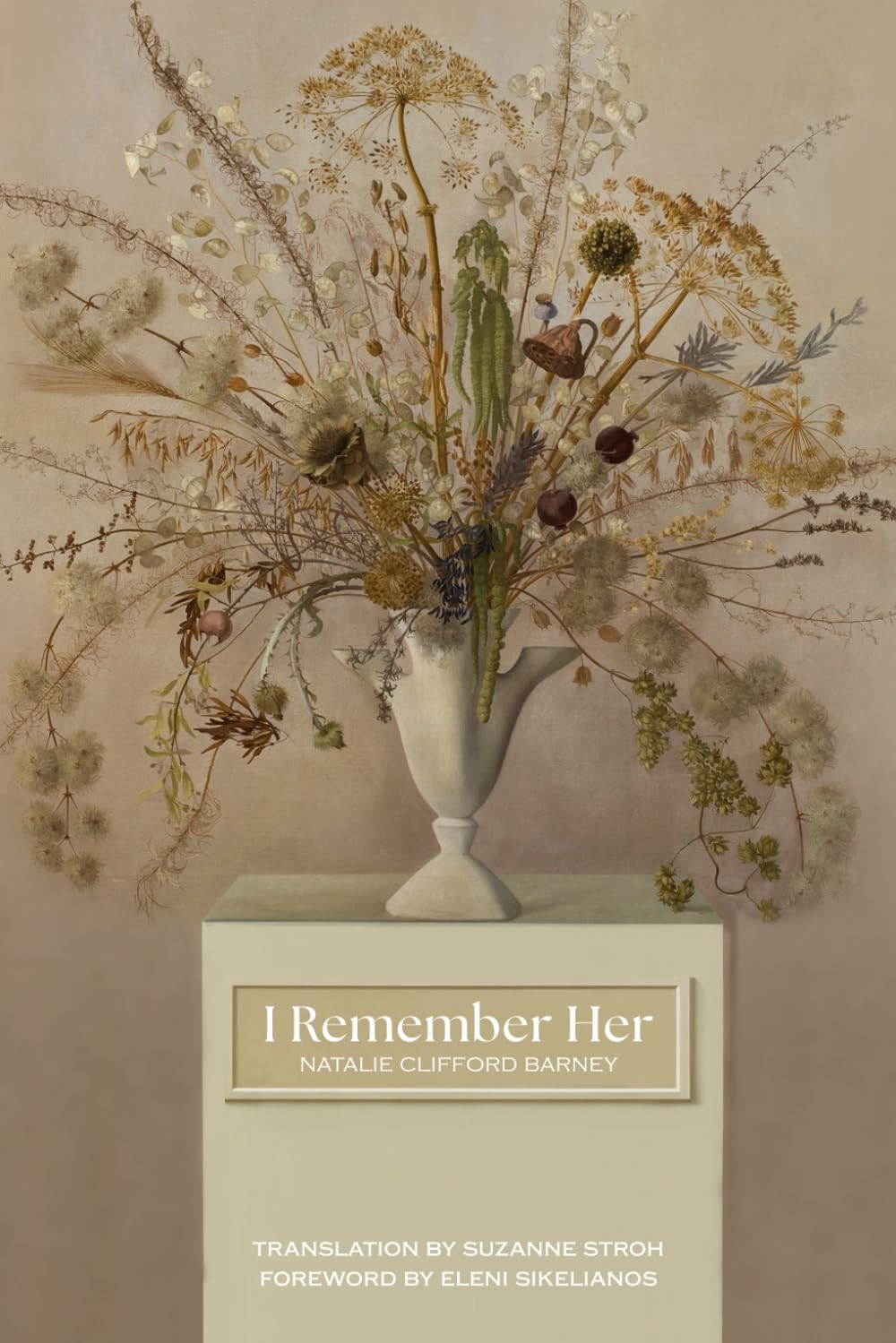
I Remember Her
Natalie Clifford Barney, translated by Suzanne Stroh
Headmistress Press, 2025, 132 pages
$30.00
Reviewed by Rhea Rollmann
This year marks the 150th birthday of one of history’s most iconic Sapphists.
Natalie Clifford Barney may have had the misfortune of being born in the United States, but once she came into her multi-million inheritance at the age of twenty-six, she settled permanently in her preferred home of Paris, where she had already lived off and on for much of her youth. There, she set out to accomplish her goal “to make my life itself into a poem,” pursuing a series of Sapphic affairs that would make an L Word scriptwriter blush. At the same time she put her inherited fortune to good use, supporting the lifestyles and art of a whole coterie of other lesbian and queer writers, artists, and poets.
Turn-of-the-century France, and Paris in particular, was preferred by Sapphists for a reason. Barney herself described it as “the only city where you can live and express yourself as you please.” As Jean Chalon put it in his hagiographic biography of Barney based on interviews conducted toward the end of her life:
The Americans of the thirties were still prudes for whom Natalie was the personification of sin. Natalie had understood this perfectly when at the end of the last century she had left her country, where, despite her fortune, she would always have been a pariah, a Sappho of Washington. (Portrait of a Seductress: The World of Natalie Barney, 1977).
Unfortunately, hurling herself into Parisian literary life meant most of her written work was also produced in French, and shockingly little has been translated into English. Happily, a new collection of her poetry has appeared in English translation. I Remember Her, translated by Suzanne Stroh, is a must for fans of Sapphic poetry and history alike, valuable as much for its extensive essay on Barney’s life (including new research) as for the beauty and rhythm of the translated prose poems.
I Remember Her was composed as part of Barney’s effort to woo back her former lover, Renée Vivien. Vivien was a poetess of British origin living in Paris, whose real name was Pauline Tarn. The two had separated after a tumultuous two-year romance, driven apart as much by Barney’s polyamorous lifestyle (she valued her autonomy and, while a fiercely loyal friend to her various lovers, refused to remain exclusively bound to any of them), as by the early death of their mutual friend Violet Shilitto. Violet was an unrequited love of Vivien’s who introduced her to Barney, and after her death, Vivien was wracked by guilt over a feeling of having neglected their friendship while in the throes of romance. Vivien left Barney and eventually wound up in the arms of another. Barney, normally the one being pursued by her various lovers, undertook a number of attempts at winning her back over the next couple of years, including hiring a professional opera singer to serenade her outside her window. The ongoing campaign did not, of course, prevent Barney from pursuing an array of other affairs at the same time.
Barney finally succeeded in getting through to Vivien through a series of elaborate ploys, which included composing and dedicating the poetry collection I Remember Her (and traveling across Europe to surprise her with it). The poems, which form a rough narrative discernible to those familiar with the two protagonists and their histories, stand beautifully on their own. In the earliest verses of the collection, full of reminiscence about the early days of Vivien and Barney’s romance, we find a beautiful testimony to lesbian love, certain to leave the reader swooning. The darker, more complex poems toward the middle of the collection—rooted in episodes of Barney’s personal history, as translator Suzanne Stroh explains—will appeal to the gothic reader of any persuasion. The collection ends on melancholic notes of passion and pathos.
While Barney was highly regarded by the intellectuals and literati of her era, she is not well remembered today. Despite not having achieved lasting fame as a writer, she certainly accomplished her stated goal of making her own life a poem. And she was integral to the literary scene of which she was a part, inspiring other writers through gifts of love and money alike. Yet her under-appreciated writing possesses its own beauty. Her autobiographical work can be sparse and to-the-point in the manner of the best memoir and reportage writers, but she also possesses an ability to turn out breathtaking lines of prose. Rather than try to turn these into poetry, she often preferred to publish them as collections of epigrams, a literary quality on display in many of the poems in this collection as well. The most moving poems are those depicting the early stages of two women falling in love.
The collection is invaluable as a contribution to the shockingly sparse collection of Barney’s writing in English translation, but it’s equally valuable for the extensive essay on Barney’s life appended to the collection by Stroh (the essay takes up about a third of the book’s 115 pages). Stroh surveys the existing English-language literature by and about Barney, and offers a beautiful précis of Barney’s early life, focusing primarily on her torrid, protracted and ultimately doomed relationship with Vivien. Vivien, wracked by illness in part due to her extensive drug and alcohol use, died in 1909 at the age of thirty-two. Stroh explores the complex twists and turns of their relationship, which is riveting in its own right. But far from serving merely as a lurid glimpse into Parisian sapphistry, the essay is also immensely helpful in unpacking the subtle meanings of the poetry.
I initially wondered why the explanatory text was not situated at the front of the book, so as to equip the reader with a deeper understanding of the context prior to reading the poems. But the more I thought about it, the more I approved of Stroh’s choice. Entering into the poem without too much biographical context forces the reader to experience and appreciate it on its own, savouring the construction of phrase and use of language, along with the delicate and erotic imagery, and without reading any deeper, more precise historical meaning into it. Sometimes the mind—as well as the heart—needs to encounter a poem on its own terms, to more fully lose oneself in the miasma of images and feelings it evokes. The historical essay then provides a gratifying digestif, cooling the reader’s passions in the wake of Barney’s heady, heartfelt prose. Stroh deserves immense credit for her dedication in bringing Barney’s life and work to the attention of a new generation.
150 years after her birth, more than fifty years after her death (she lived to the age of ninety-five, embarking on her final romantic liaison in her eighties with a woman nearly three decades younger), Barney continues to compel. What draws us to her? In her 1988 study of Barney and Vivien’s relationship and writing, The Amazon and the Page, Karla Jay wrote that “Barney and Vivien felt that their work had to be lived in order to be valid” and undoubtedly this interface of poetry with lived experience is one feature that elevated the seductive quality of their writing and wooed readers then as now. On a surface level, Barney appears to be the archetype of the original sapphic heartbreaker, drifting from one remarkable romance to another, transported atop a rich bed of early-twentieth-century poetry and art. Barney was a passionate and articulate champion of Sapphic life. She was more than a heartbreaker: she thought deeply and wrote about the nature of friendship and loyalty, both of which she valued and practiced exceedingly well. Those who merely see her as a wealthy, sexually adventurous patron of the arts miss her most important qualities as a writer, a thinker, a philosopher, and a theorist who did not merely write and appreciate poetry, but lived and breathed it in the truest sense. She was a modern woman decades ahead of her time; one who possessed all the troubling faults of any rich person (for instance an inability to see beyond her bubble of privilege), yet one who also carved a courageous and unapologetic path for contemporary queer lives. I Remember Her is an excellent starting point for those interested in studying this remarkable woman, a muse and an inspiration to generations of artists. Stroh’s translation and accompanying essay is a worthy and overdue tribute for this Amazon of love and letters.
Rhea Rollmann is an award-winning journalist, writer, and audio producer based in Canada. She’s the author of A Queer History of Newfoundland (Engen Books, 2023) and has an extensive background in queer, trans, and labour activism.
"Empowerment comes from ideas."
― Charlene Carruthers
"Your silence will not protect you."
— Tourmaline
"Gender is the poetry each of us makes out of the language we are taught."
— Leila Raven